 Thailand – February 2025
Introduction
We’d been planning a trip to Thailand for a while and arranged everything from flights, hotel bookings, guides and transport, using Booking.com for a lot of it. We planned a couple of days in Bangkok just being tourists as we were first time visitors. Then a day at Pak Thale for my most wanted bird – Spoon-billed Sandpiper – for this I had contacted Nick Upton who arranged for Peter Ericsson to guide us, followed by three days at Baan Maka Nature Lodge in Kaeng Krachan National Park, booking a guide for a day and a half’s guiding and a night walk. From there we would move on to Khao Sok, where we booked a guide for a day, then finally to Khao Lak for four days so Bridgette could do some diving, including a night away on a live-aboard boat.
Day 1 – February 14th – Travel Day
We started our trip with a taxi into Gloucester at 8am where we caught the National Express coach to Heathrow for our afternoon flight to Doha with Qatar Airways and then on to Bangkok. We had used Qatar Airways before and had found them to be excellent. The trip to the airport was enlivened by 28 Red Kites along the route. Our flight left on time at 2:55pm, it was 6 hours 40 minutes to Doha, but because of the changing time zones we arrived at half past midnight. Bridgette wanted to break the flights up rather than take the arduous direct flight. The transfer at Doha was smooth with no further security or complications. We had a couple of hours to relax before our 2:30am flight to Bangkok.
Day 2 – February 15th – Still travelling and Park Life
We landed at Bangkok at 12:50pm. It was very busy, but we were well organised. The taxi from the airport to our hotel through Booking.com cost just £13. I bought an eSim with Airalo before I left the UK for £17, giving unlimited data, texts and calls for 15 days. Our bags arrived quickly, and we had directions where to find our taxi contact. There was a wall lined with names of arrivals arranged by company, I found my name and we were directed outside into the searing heat and humidity. Here it was chaotic, with four lanes of taxis trying to pull into the few spaces by the kerb, all directed by a policewoman frantically blowing a whistle. We had been told our taxi’s number plate and eventually spotted him and waved him down. We climbed into the taxi’s welcome air-conditioned interior and were underway to our hotel. The greatest decision made was not to drive in Bangkok, or anywhere else, the traffic was crazy.
I had of course already started a bird list, a Little Egret was seen from the plane beside the runway, 4 Feral Pigeons scavenged around the taxi ranks and then as we pulled away the first, 4 easily identified GREAT MYNAS with their punky crests.
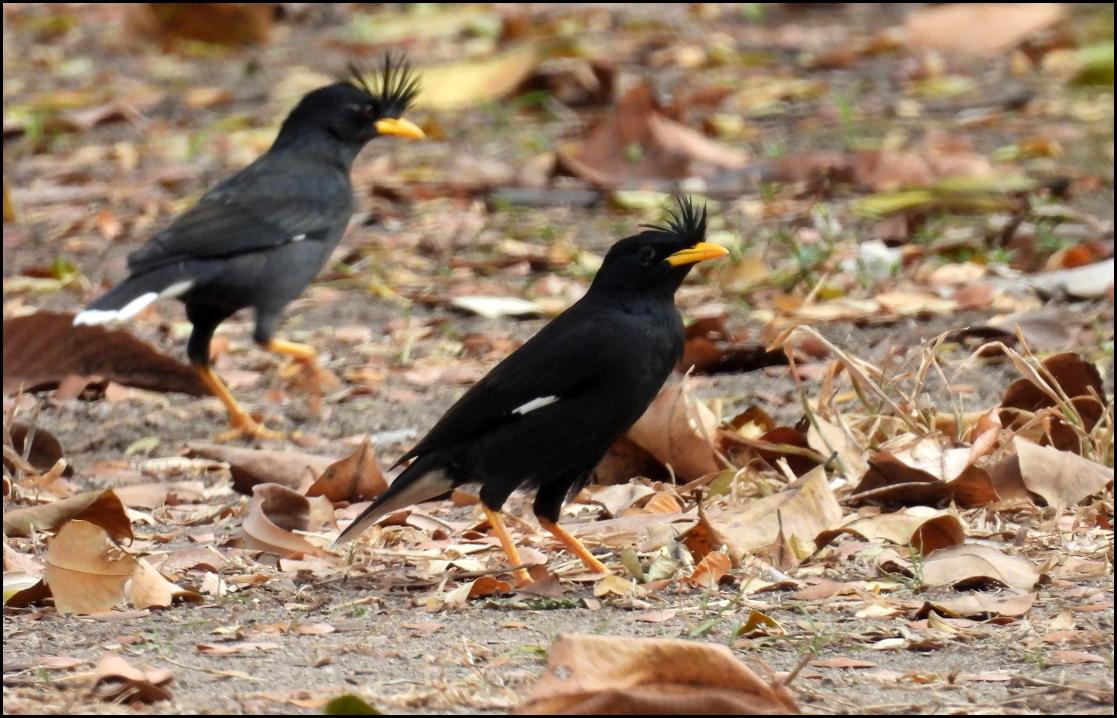
Great Mynas
We stayed at the LUXX Lang Suan hotel next to Lumpini Park, taking about 45 minutes to get there. Approximately 22 hours after leaving home we were at our hotel. Three nights in a studio cost £188 (THB 8097) arranged through Booking.com. Thankfully, the girls on reception spoke excellent English as our grasp of Thai wouldn’t get us far. Google Translate is your friend.
We made a cup of tea and Bridgette decided to nap for an hour whilst I birded from the balcony and started to get to grips with a whole new set of birds. Armed with a camera and Lynx’s Birds of Thailand I saw 5 species in that hour. I also used the iNaturalist app to quickly ID photos. We overlooked a small garden and a few trees but otherwise we were bordered with skyscrapers. Lifers were 2 ZEBRA DOVES, a STREAK-EARED BULBUL and a male ORNATE SUNBIRD (all lifers in capitals hereon). The other species were 2 Spotted Doves and 4 Common Mynas, which I had seen before on my only Asian day in Hong Kong and in New Zealand.
We decided we couldn’t turn in yet, even though our body clocks were 7 hours ahead so headed out to explore Lumpini Park, a 5-minute walk. This was where Sir David Attenborough had filmed Water Monitors for the Asia series. As we arrived at the park 2 PAINTED STORKS soared overhead and just inside the gates were 20 Large-billed Crows. For a very noisy and busy public park that gets up to 15,000 visitors a day there were a lot of birds. We saw the first of 7 WATER MONITORS at very close range. The new trip birds were a SIAMESE PIED STARLING, an ASIAN PALM SWIFT, an INDOCHINESE ROLLER and 2 ASIAN OPENBILLS. Also 17 Tree Sparrows, lovely to see as they’re so hard to find back home now, 3 Oriental Magpie-Robins, a Striated Heron, 22+ Black-collared Starlings, an Ashy Drongo, a Yellow-browed Warbler and a Scaly-breasted Munia. FINLAYSON’S SQUIRREL was a new mammal.
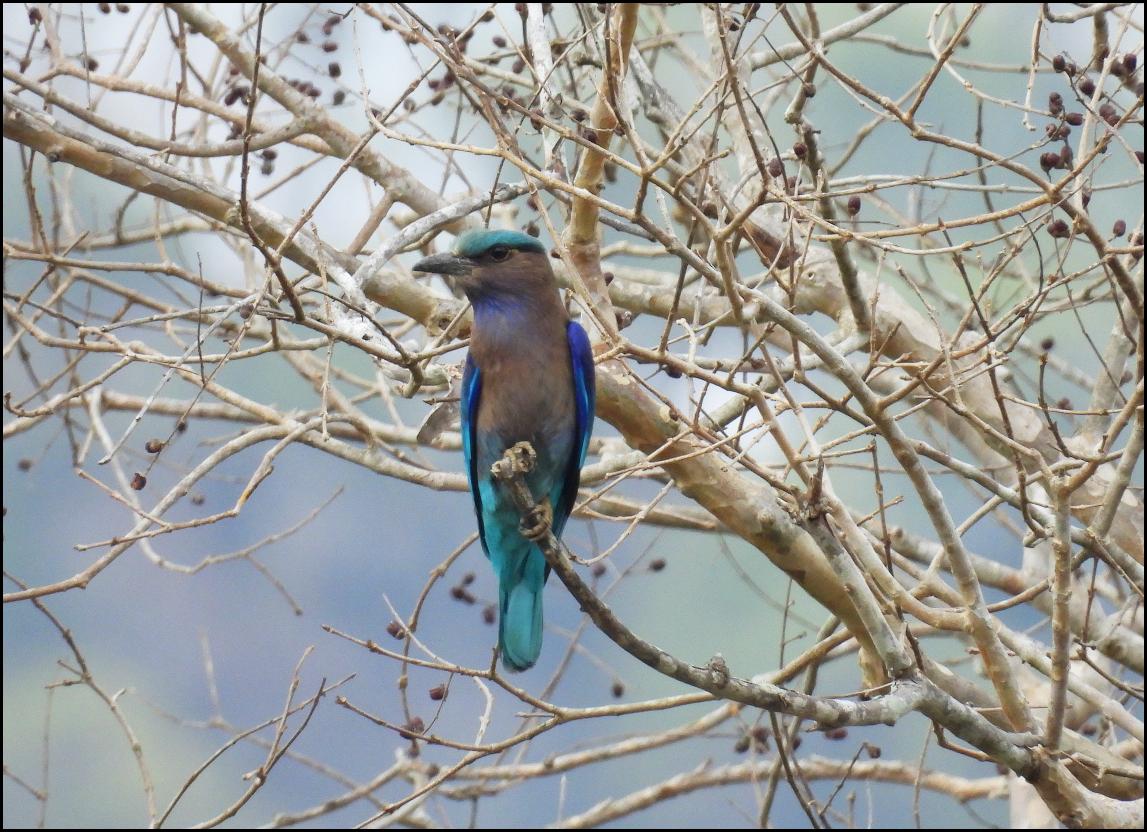
Indochinese Roller
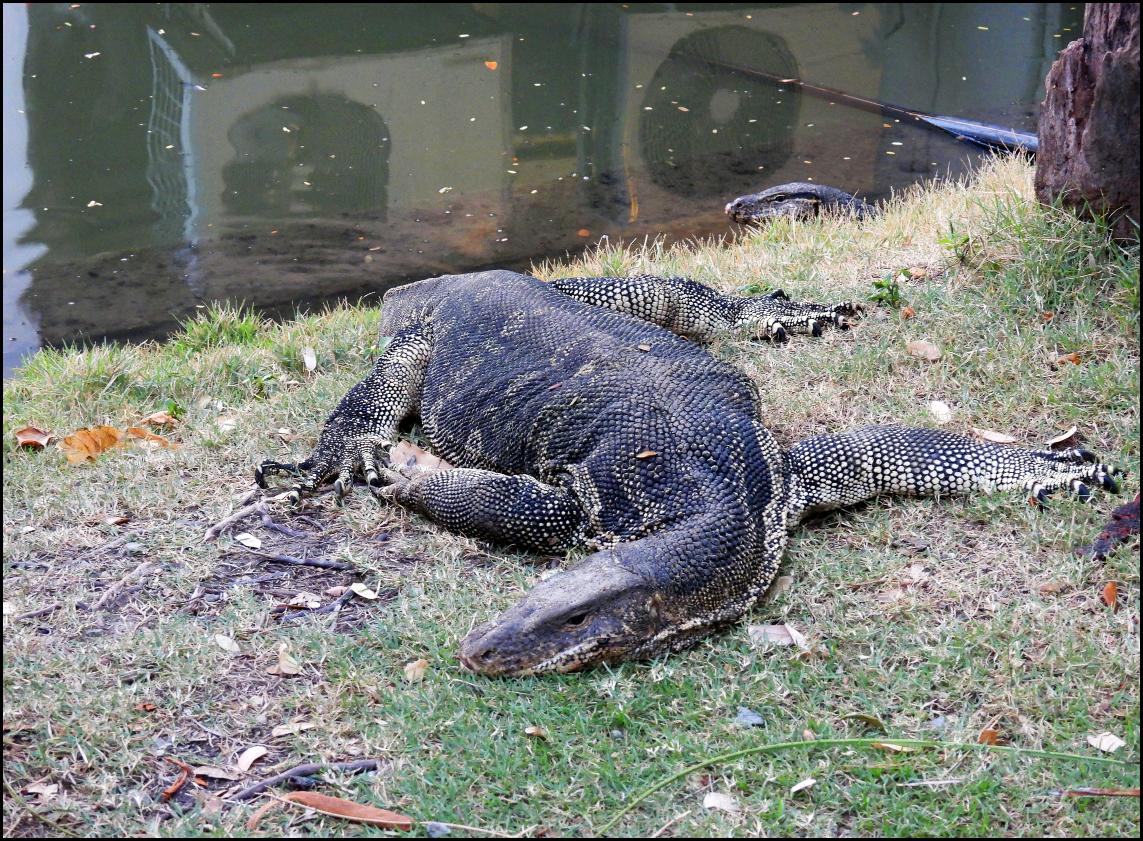
Water Monitor
Flagging from heat and humidity and jet lag we decided to call it a day. On the way back to the hotel we called in at a 7-11 to buy snacks and a couple of toasted sandwiches, which are a thing out here. They cost about £1 each and were very tasty.
Day 3 – February 16th – Early Park birding and being tourists
I was awake before dawn and after a coffee I was off to the park for early birding before succumbing to a tourist day. Even at 6am on a Sunday there were hundreds of runners already circling the park. New trip birds were 6+ EDIBLE-NEST SWIFTLETS (aka White-nest Swiftlets) and an ASIAN PIED FANTAIL. Also 2 Great Egrets, a White-throated Kingfisher, a Brown Shrike, an Asian Koel and 3 House Sparrows. Back at the hotel I added a male BLACK-NAPED ORIOLE.
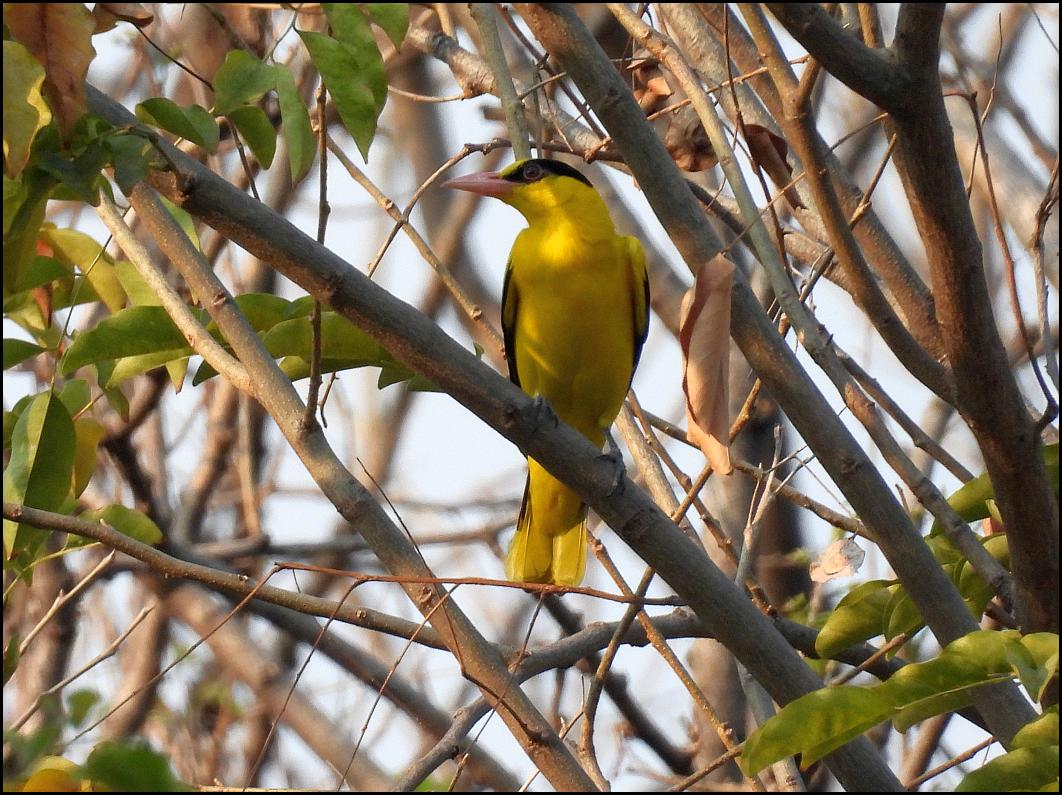
Black-naped Oriole
Using the excellent Grab app (like Uber) I ordered us a taxi to the Grand Palace which would put us near most of the main popular sites. It cost THB 140 (£3.20). Here I think we fell into the Tourist Trap, but as it turns out it was a good tour and very reasonable. The taxi dropped us at a stand where a young Thai man with the patter of ‘Del Boy’ descended on us. He said the Grand Palace didn’t open until 11am on a Sunday as it was closed for prayer, then informed us we were not dressed correctly. We both had calf length clothing, but ankles must be covered so he sold me snazzy elephant-patterned trousers and a wrap for Bridge. Then he sold us a tour, as I was saying ‘no thanks’ Bridgette said yes so that was that. He said we must say that he was our Thai son then we would get Thai prices instead of foreigner prices. He summoned a Tuk-tuk, probably another family member, who took us to the dock. When we arrived there a lady, probably his mum, descended on us and sold us boat tickets at “Thai prices” and promised good seats. She swept us onto the dock and installed us in the best front seats of a Thai long-tail boat.
We first travelled upriver to look at a new modern bridge and then down the other side to the floating market at Wat Kamphaeng Bancak, stopping for 20 minutes. We bought excellent fruit smoothies there. Back on the boat, we travelled a short distance before stopping at Wat Pak Nam to admire a temple for a short while. Then we were taken back to the other side of the river where the tour ended.
On the journey back I ticked 2 LITTLE CORMORANTS and a BLUE-TAILED BEE-EATER sat on wires. There was also 2 juvenile Pond Herons, I later found out juvenile Javan and Chinese can’t be reliably separated here.
We got lunch and a welcome cold beer before going to the Wat Pho temple complex. The temples were fantastic and included the Temple of the Reclining Buddha, a giant gold-covered Buddha 46 metres long. The only bird of note was my first ASHY WOODSWALLOW flycatching from the top of a temple. It was too hot to do the Grand Palace, so we would do that tomorrow. It was extremely hot, and we walked until we found a Metro station. We paid THB 60 (£1.37) each for a ticket back to Lumpini Park. However, the station was at the far end of the park and found we were two miles from the hotel. Here we did get over-charged, we were too worn out to walk in the heat, so got a Tuk-tuk back. He wanted THB 400, but I only had THB 370 (£8.48) left with me, so he accepted that. Thailand is very much cash driven and there are very few places where cards are welcome outside of hotels, restaurants and malls.
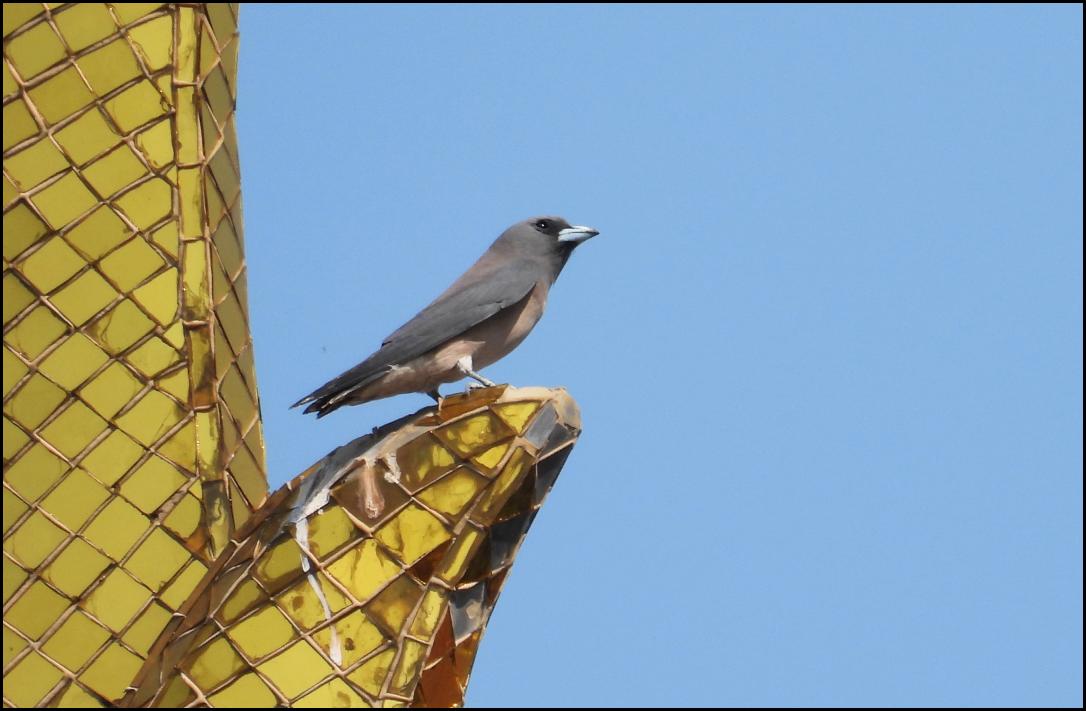
Ashy Woodswallow
We stayed in that night and ate snacks, birding from the balcony until dusk. YELLOW-VENTED BULBUL was the final tick of the day.
Day 4 – February 17th – Parks and Palaces
I was up at dawn again and off to Lumpini Park. There were many birds again, the only new one was an INDIAN CORMORANT drying its wings in the sun. I returned to the hotel, ticked SCARLET-BACKED FLOWERPECKER from the balcony and planned for the day.
We walked to Benjakitti Park, half an hour away, entering along the skywalk. It seemed remarkably familiar as we had watched several YouTube videos about the park. It was very quiet compared to Lumpini with very few people around. We were too late for birding and were already realising this holiday wasn’t going to be long enough as we wouldn’t get the chance to explore it properly. Two Plain Prinias near the entrance were new for the trip. A GREATER COUCAL was the only tick, but we had nice views of an Indochinese Roller. It was particularly good for dragonflies, and I managed to identify DITCH JEWEL, ORIENTAL BLUE DASHERS and COMMON PARASOLS and TROPICAL FIRE ANTS on the seat where we took a drinks break. We exited the park at Queen Sirikit gates and used the Grab app to order a taxi to the Grand Palace.
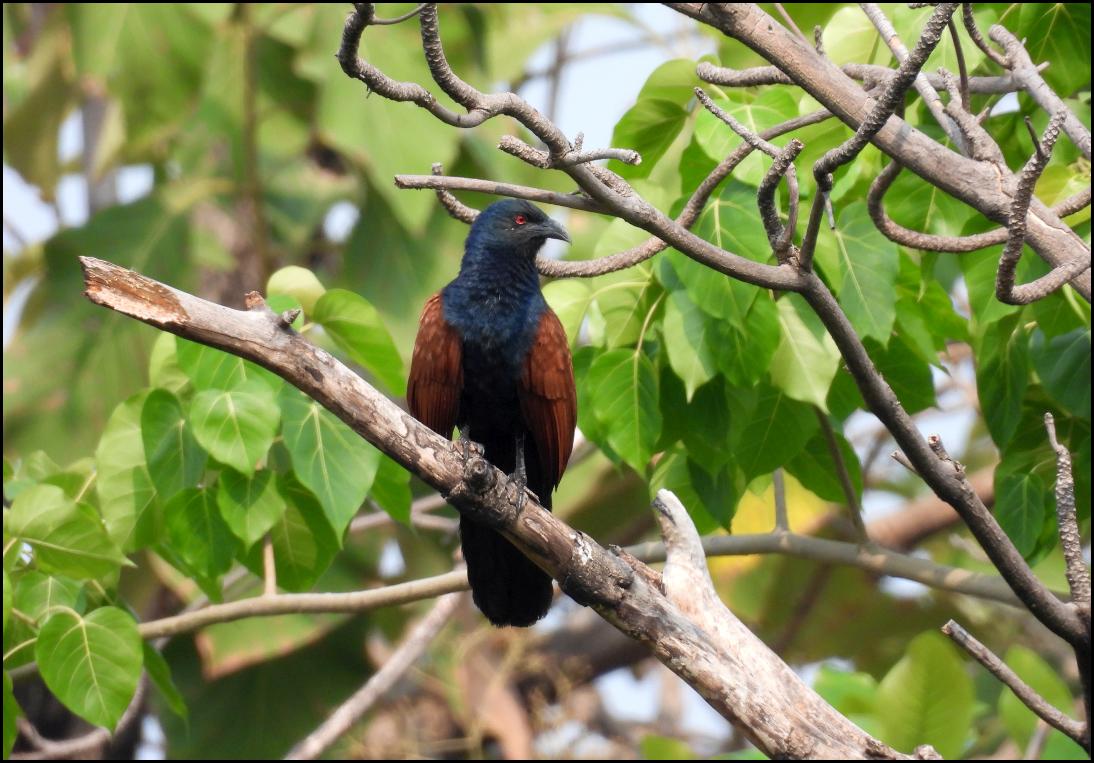
Greater Coucal
At the entrance to the Palace the security guards made sure I put on the elephant trousers and Bridgette, the sari. Our Thai friend was correct. The Palace was even more ostentatious than anything we’d seen yet and spent a couple of hours just wandering the site.
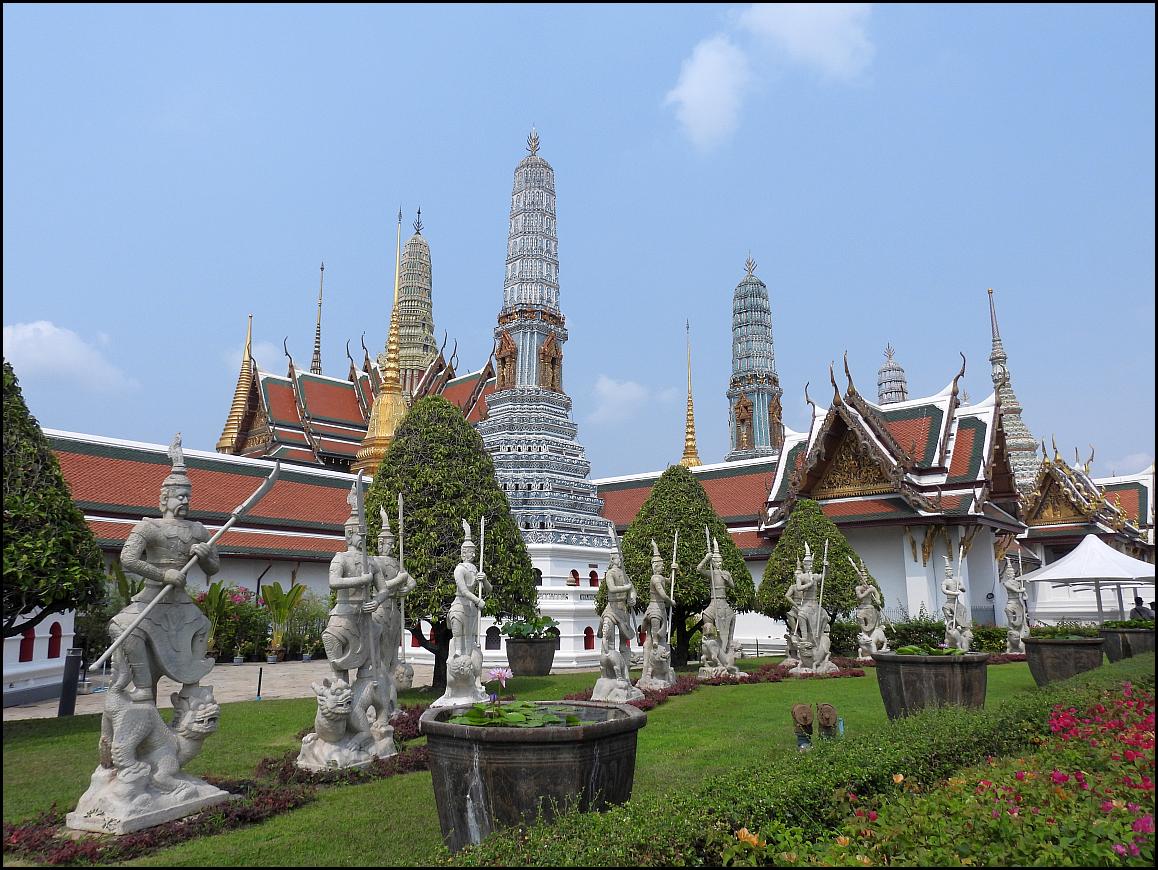
Grand Palace
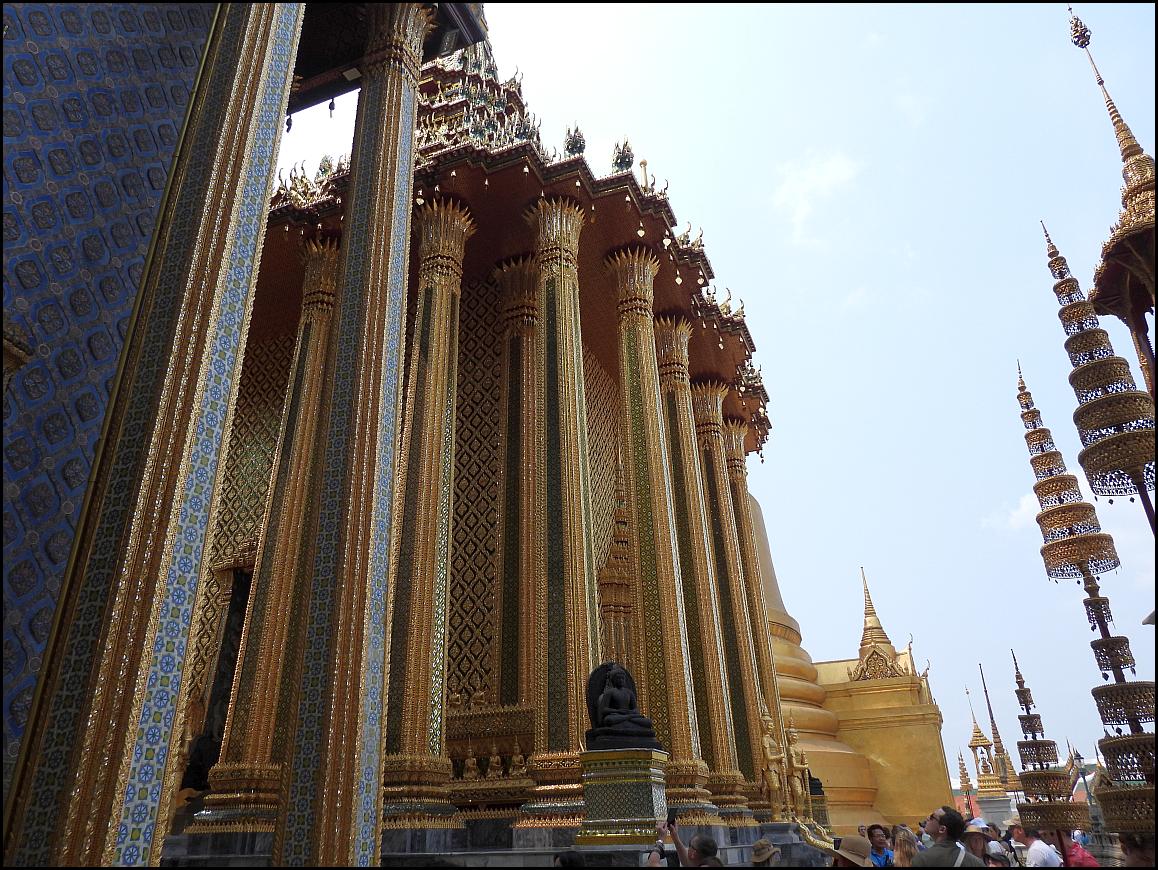
Grand Palace
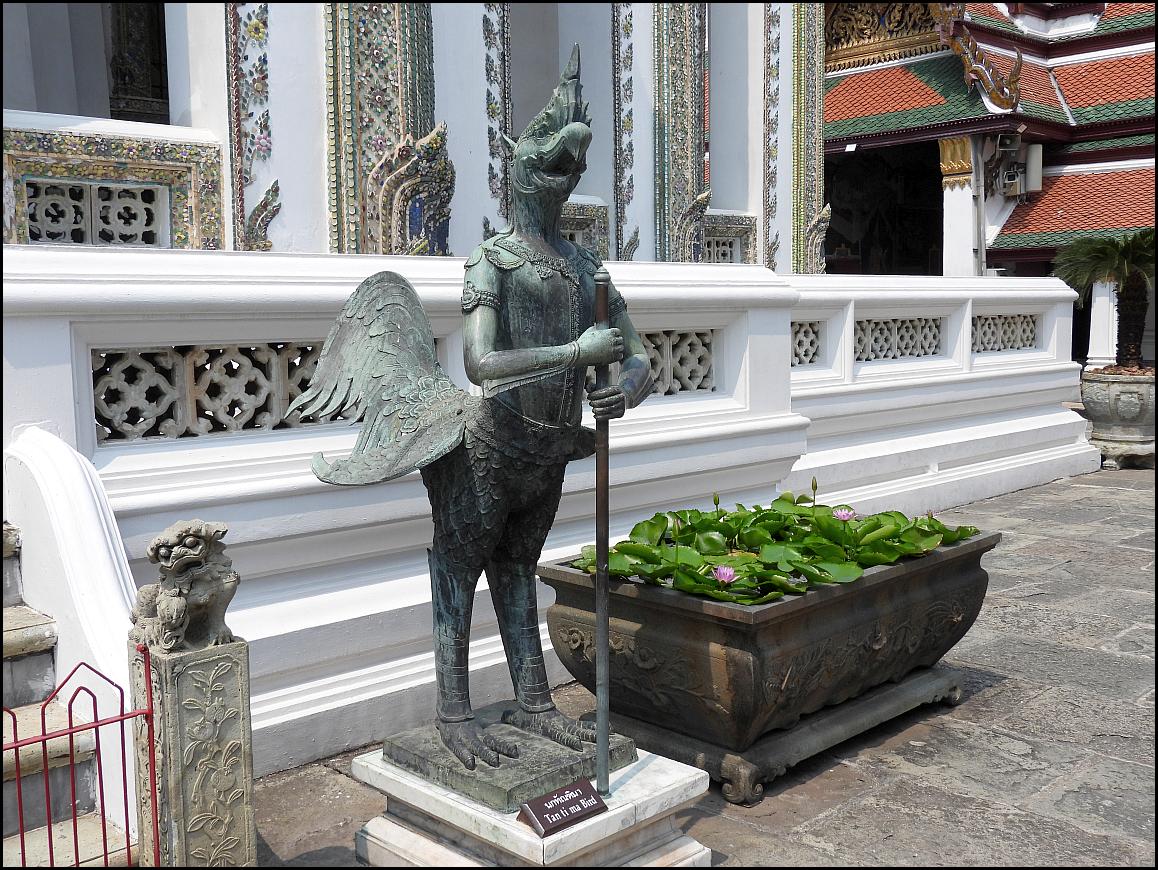
Tan ti ma Bird, definitely a tick
We had lunch and crossed the river to visit Wat Arun, another stunning pyramid-shaped temple that looked fantastic. The river crossing was THB 20 (£0.46) each way! The temple was beautiful, but it was overwhelmed by Instagram girls (and a few boys) all in national costume and some with private photographers in tow. I just found a quiet corner and dozed in the shade whilst Bridgette explored.
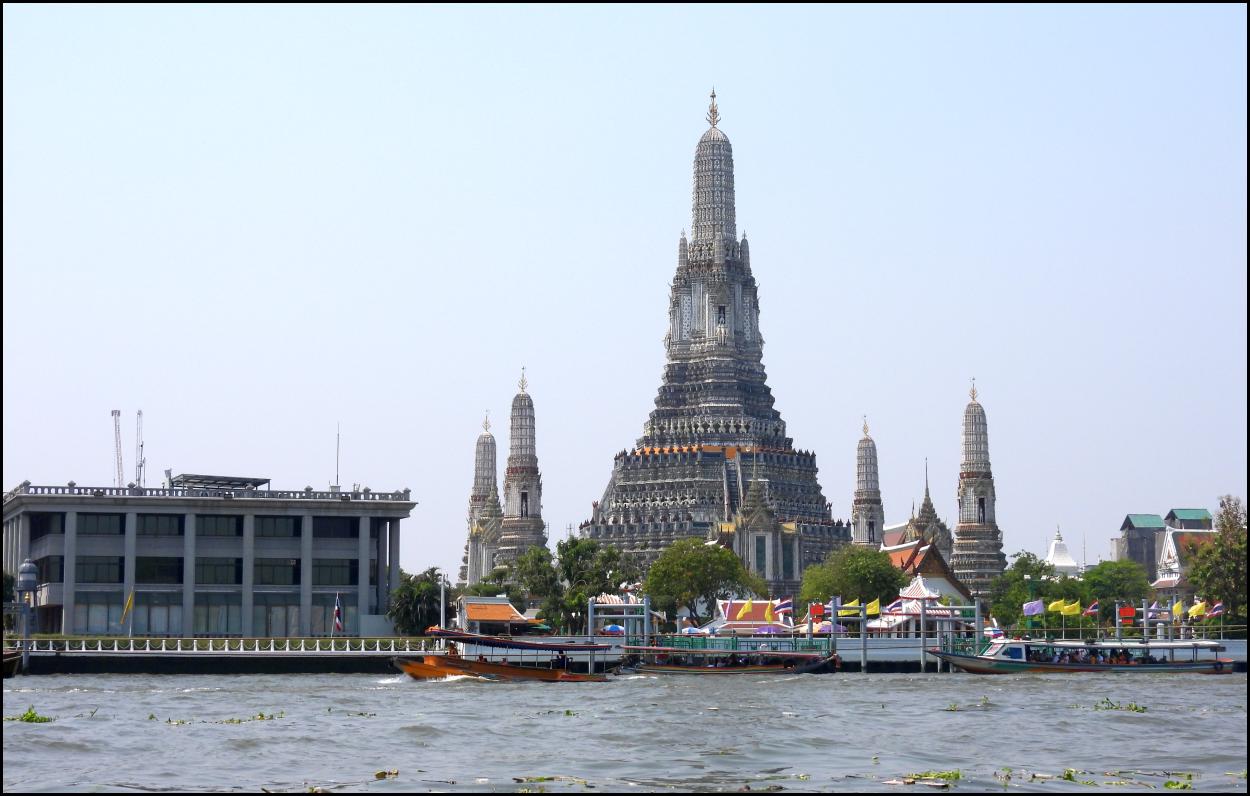
Wat Arun
We walked back as far as Chinatown before grabbing a taxi home. I ticked COPPERSMITH BARBET from the balcony. We went out for a very nice meal in a nearby restaurant. Most main courses are less than £5 and a large beer is around £2.50. We had an early night as we had a 5:30am start in the morning.
Final top tip for Bangkok, have toilet tissue in your bag. 90% of public toilets don’t supply it.
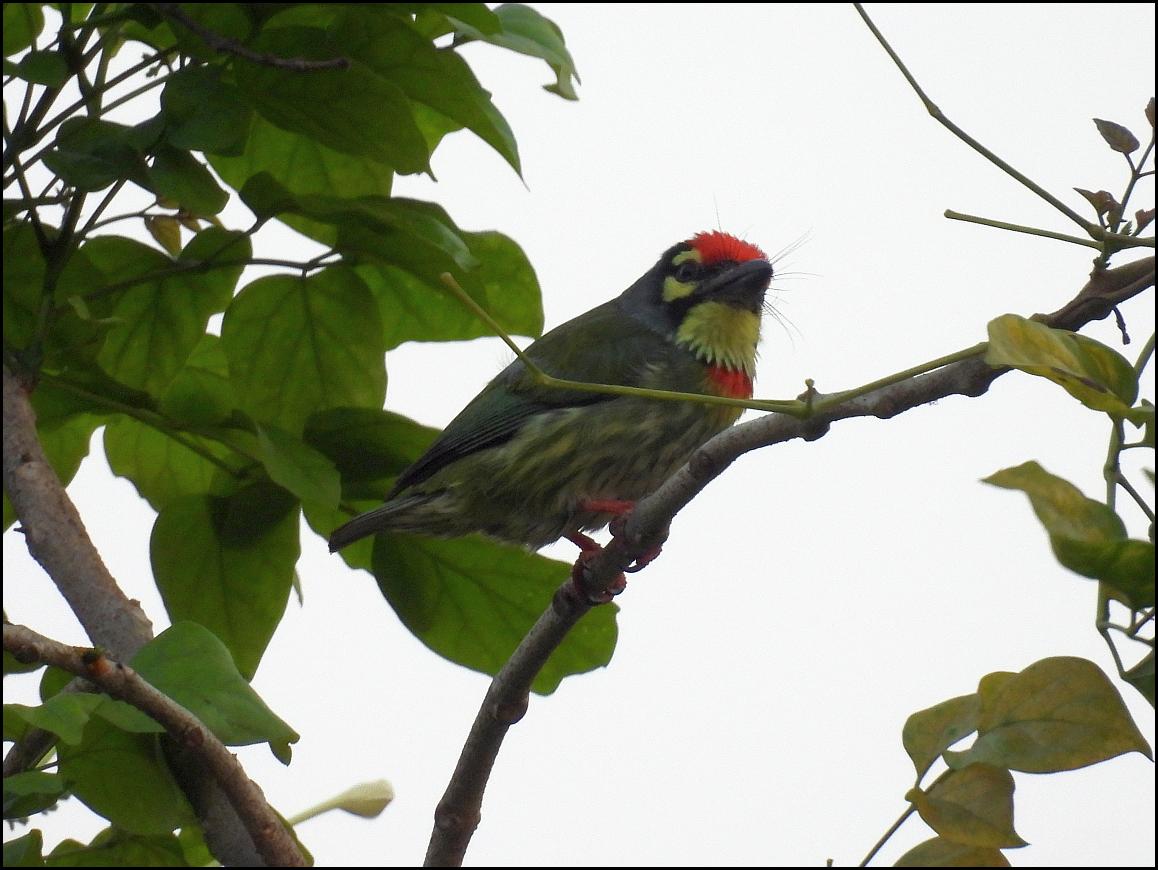
Coppersmith Barbet
Day 5 – February 18th – Seeking Spoony
Today was a day I’d been waiting for a long time. We were heading to Pak Thale, hopefully to see Spoon-billed Sandpiper. Peter Ericsson picked us up at 5:30am and drove south for a day’s birding. We made excellent time, arriving at Ban Laem saltpans at 6:45am. We enjoyed getting to know Peter on the journey down. He is a very experienced birder from Sweden who has lived in Thailand for over 40 years. We were in good hands.
Arriving by the salt pans we could see there were wading birds in every direction. There was a gathering of Painted Storks and egrets, the waders included 100 TIBETAN SAND PLOVERS, my second Long-toed Stint, 100+ Red-necked Stints, 20+ Marsh Sandpipers, 10 Curlew Sandpipers, 14 Black-winged Stilts, 6 Spotted Redshanks, 20 Grey Plovers, 3 Kentish Plovers and 6 Common Greenshanks. This was just a small area, how were we ever going to find one small special bird amongst this lot? On wires close by was a RED-COLLARED DOVE.
We moved on to the Pak Thale complex of pans, with even more waders here. We checked each pan before moving on to the next, the wader totals increasing as we went. Another group of birders were searching, Peter rang the group leader, they had had a Spoon-billed Sandpiper very briefly before it flew off. At least there was one here. Peter led us towards the sea. After nearly 2 hours we’d seen another 100+ Red-necked Stints, a further 1100 Tibetan Sand Plovers, a Kentish Plover, 10 Red Knots, 90 more Curlew Sandpipers, another 2 Marsh Sandpipers, 150+ Terek Sandpipers (I’d seen 1 before), 10 Greater Sand Plovers, 4 Common Redshanks, 100+ Broad-billed Sandpipers, 8 Turnstones, 2 Sanderlings and a Common Sandpiper. Other birds included 200 BROWN-HEADED GULLS, 50 Caspian Terns, 3 Whiskered Terns, 4 Little Terns, 200+ Indian Cormorants, 4 Barn Swallows and a BRAHMINY KITE.
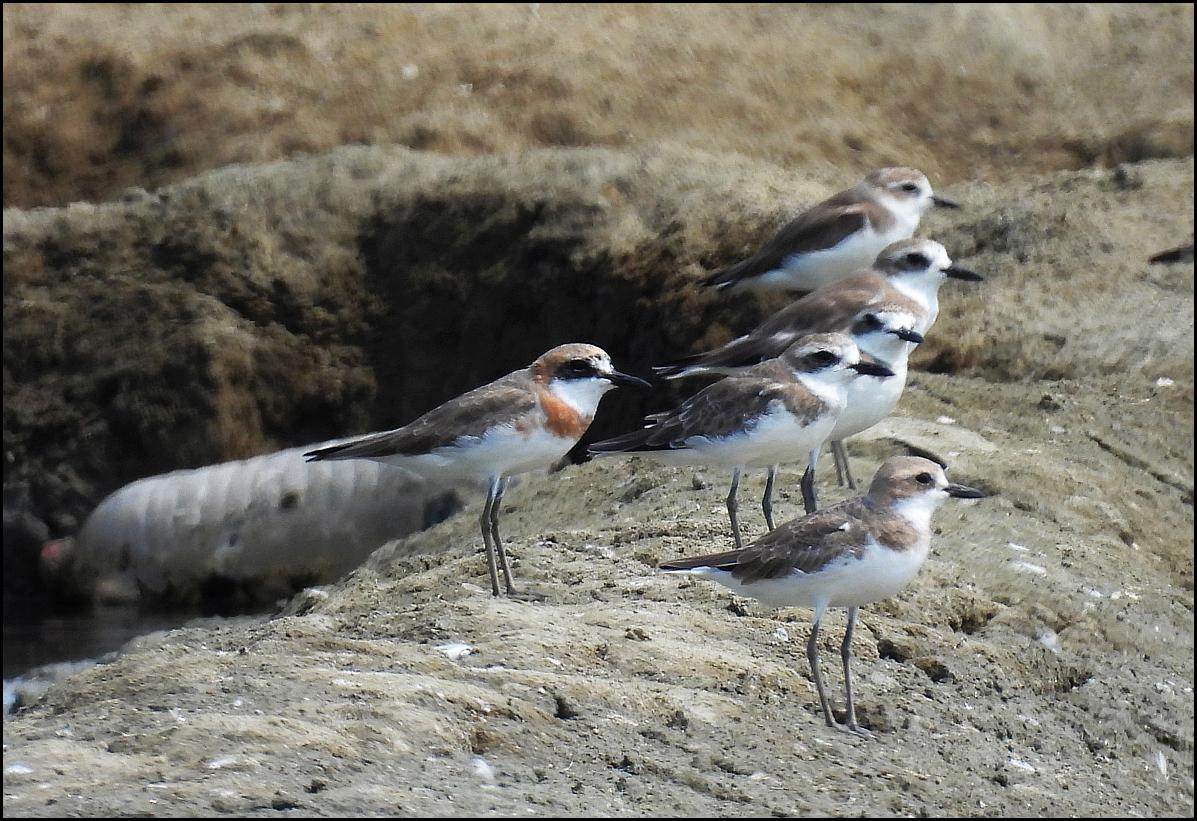
Greater Sandplover & Tibetan Sandplovers
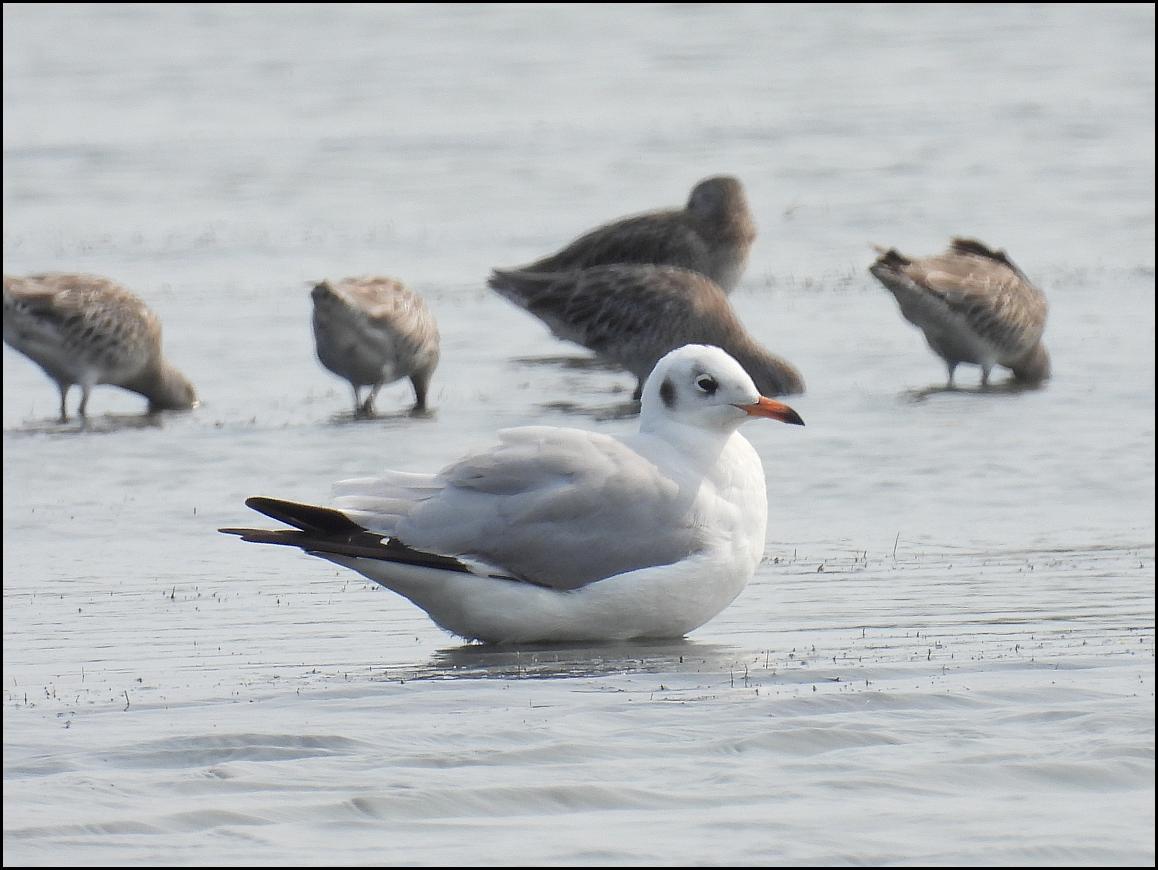
Brown-headed Gull
After 2 hours Peter said, “I’ve got it!” and then “Don’t panic, look in here” as I wildly scanned with my scope. We took turns to look at the mega-rare, endangered SPOON-BILLED SANDPIPER, a small sandpiper with a diagnostic spoon-bill. Fantastic! I found it in my scope, watched it for a while, then took pictures and filmed it, downloading a couple instantly to my phone “just in case.” My camera had died on the second day in Tobago, so I was wary this time. Peter rang the other group; they joined us and were as ecstatic as we were. We watched the Spoony for another half an hour as it was very settled and then we moved on.
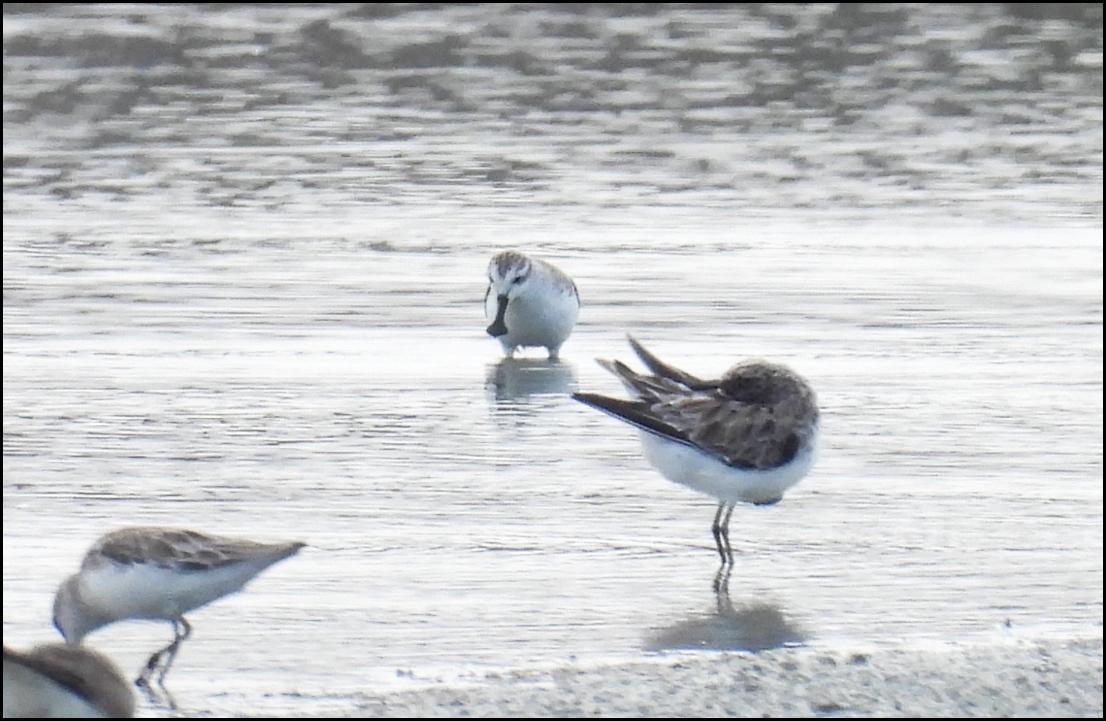
Spoon-billed Sandpiper
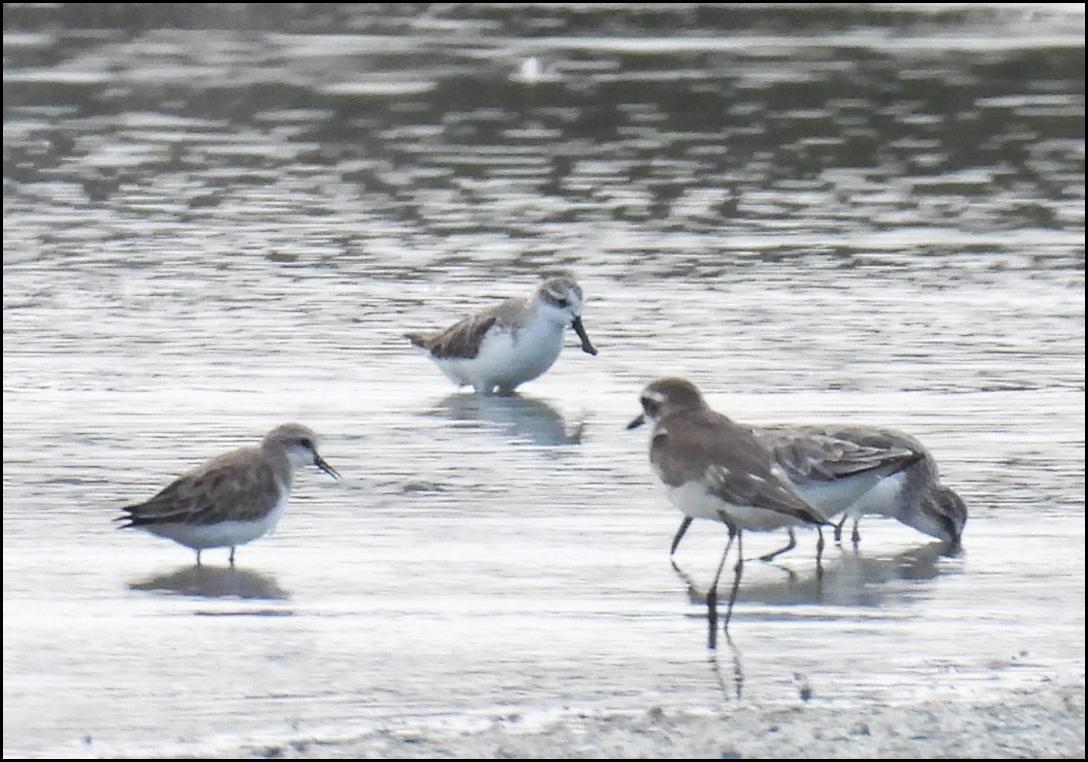
Spoon-billed Sandpiper
Peter spotted an ASIAN DOWITCHER on a distant pan and declared there ought to be more. After walking closer, we found he wasn’t wrong, there were over 100 with 25 Black-tailed Godwits and a Whimbrel and another 25 Painted Storks.
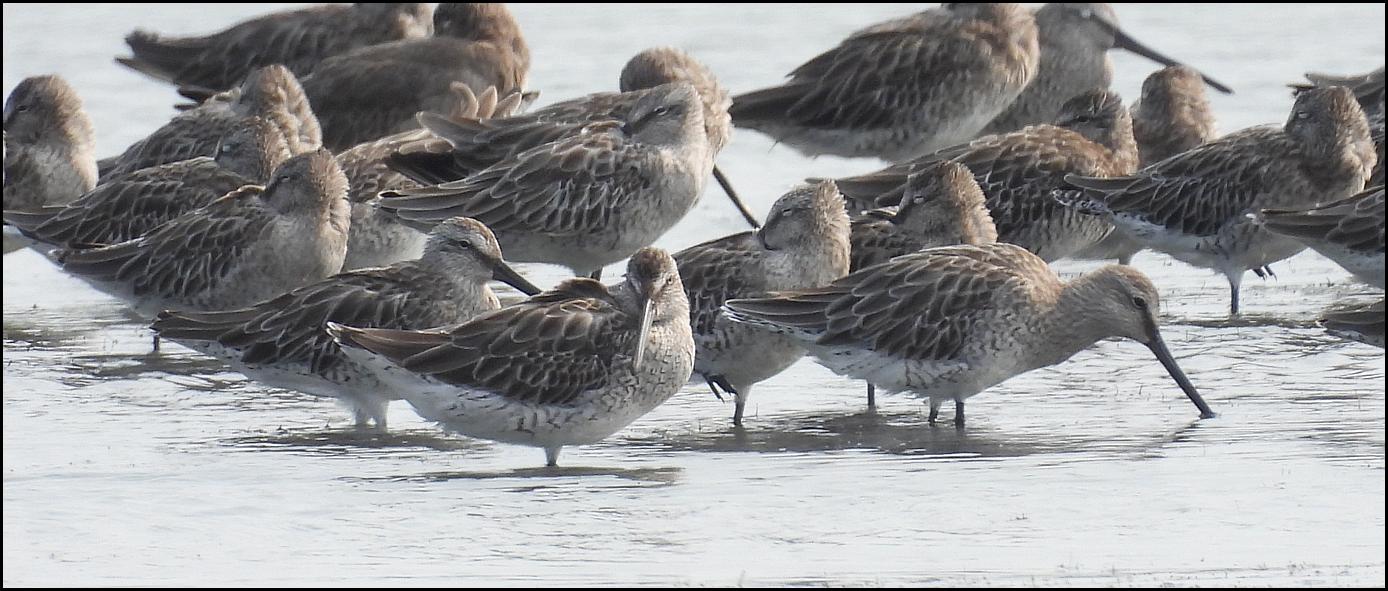
Asian Dowitchers
We walked back to the car and headed for Laem Phak Bia, stopping on the way for drinks at a 7/11, and then briefly at Wat Kom Naram. Peter told us it was a site for ORIENTAL SKYLARK and immediately found one. We also had a Wood Sandpiper and a Plain Prinia here. It was fiercely hot when we arrived at Laem Phak Bia. Peter led us off into the centre of the pans. There were more waders here, but the special ones were 10+ NORDMANN’S GREENSHANKS, another endangered species. Also here was a brief Pacific Golden Plover, 100+ Great Knots (I’d seen 1 before), 200+ Curlews, 20+ Bar-tailed Godwits, 20 more Tibetan Sand Plovers, a summer plumaged Greater Sand Plover and an Avocet. Also, another Brahminy Kite and another Little Tern.
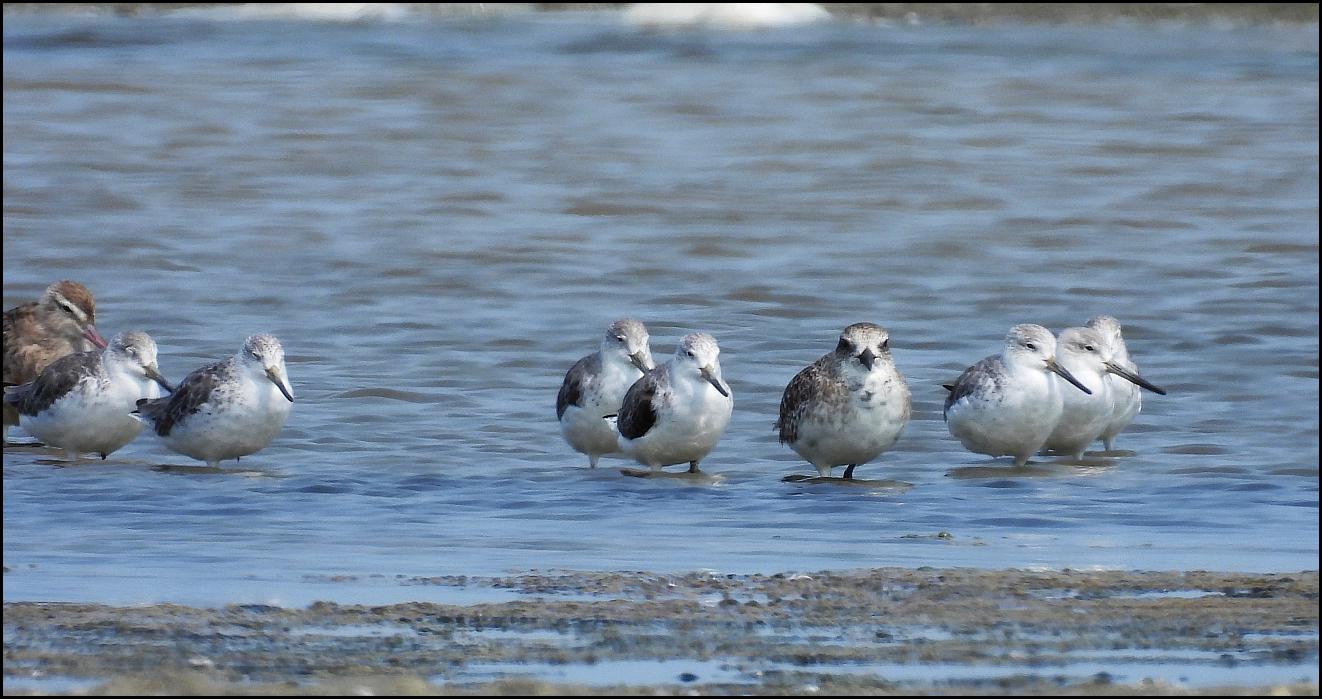
Nordmann’s Greenshanks
Peter took us for lunch at a nearby restaurant where we had fried rice with prawns, a spicy seafood soup and welcome cold drinks. A FLAT-TAILED HOUSE GECKO was sat behind the wall clock. After lunch we checked a nearby pan where we added Little Ringed Plover to the wader list. There was also 2 Wood Sandpipers, a Long-toed Stint and a brief Zitting Cisticola here.
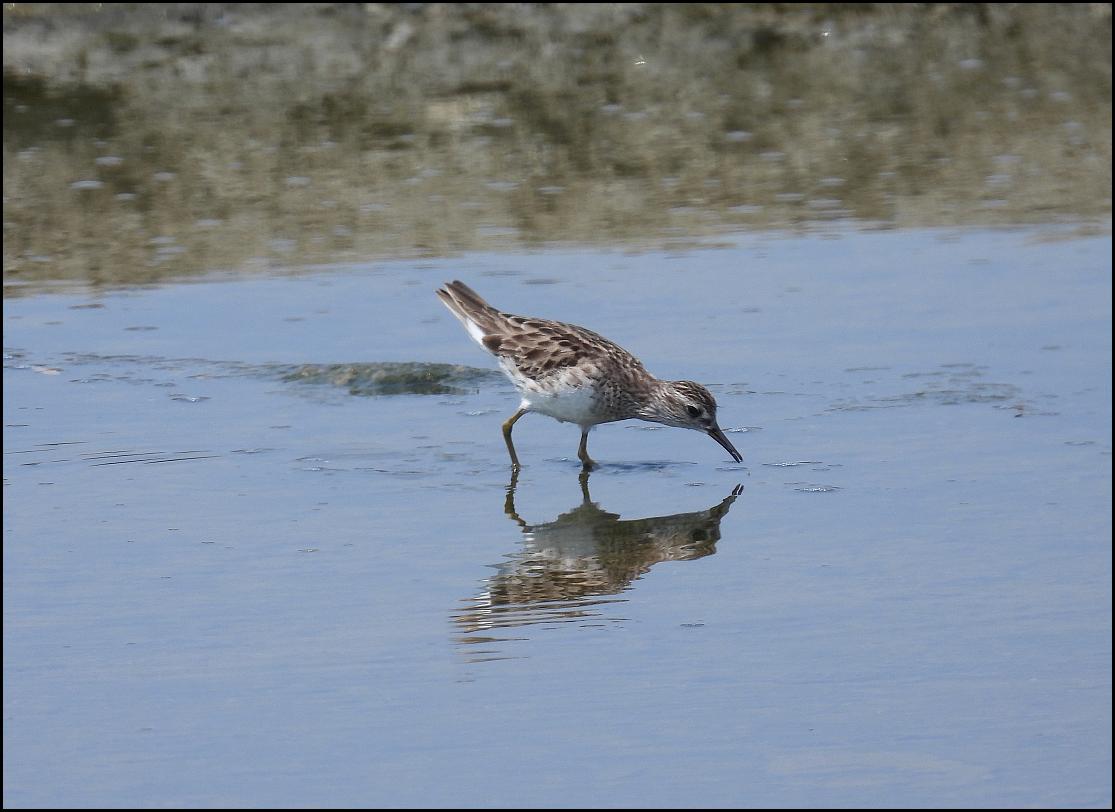
Long-toed Stint
We then drove to Bang Tabun Ok “Duck & Ibis” Lake. We immediately found 4 BLACK-HEADED IBISES, a BLACK DRONGO and a Purple Heron amongst common waterbird species. A SPOT-BILLED PELICAN was out in the centre of the lake but resolutely remained asleep on a concrete island. A distant flock of 100 Pintails were the only ducks of the holiday. As we were leaving the lake we stopped to watch a troop of 8 LONG-TAILED MACAQUES feeding on discarded fruit.
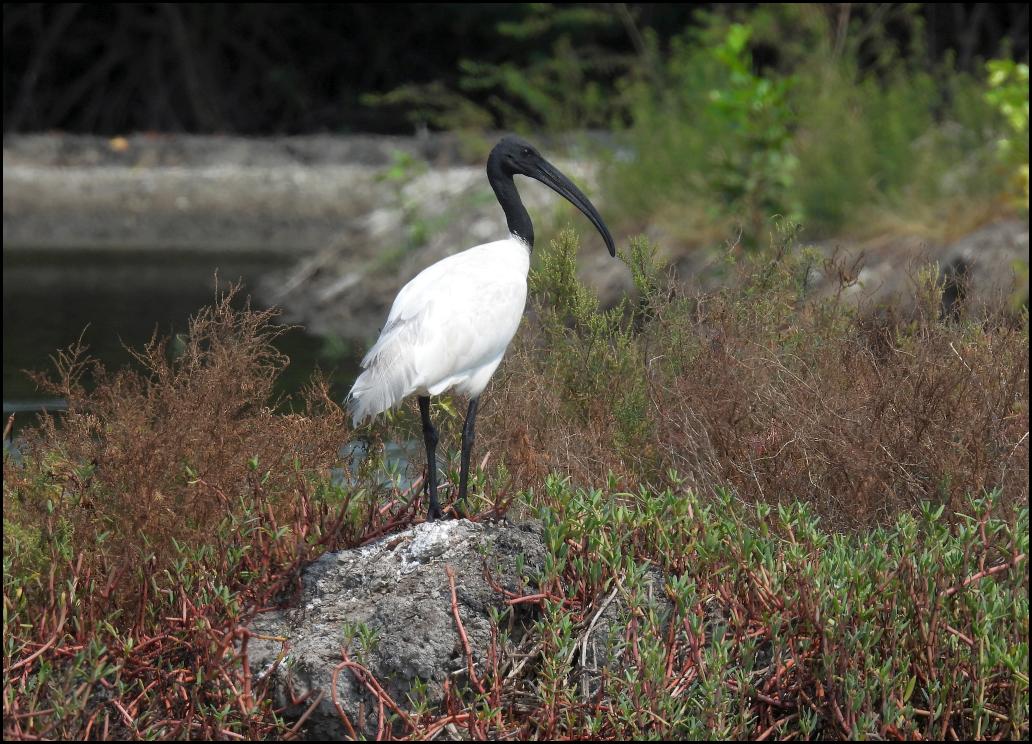
Black-headed Ibis
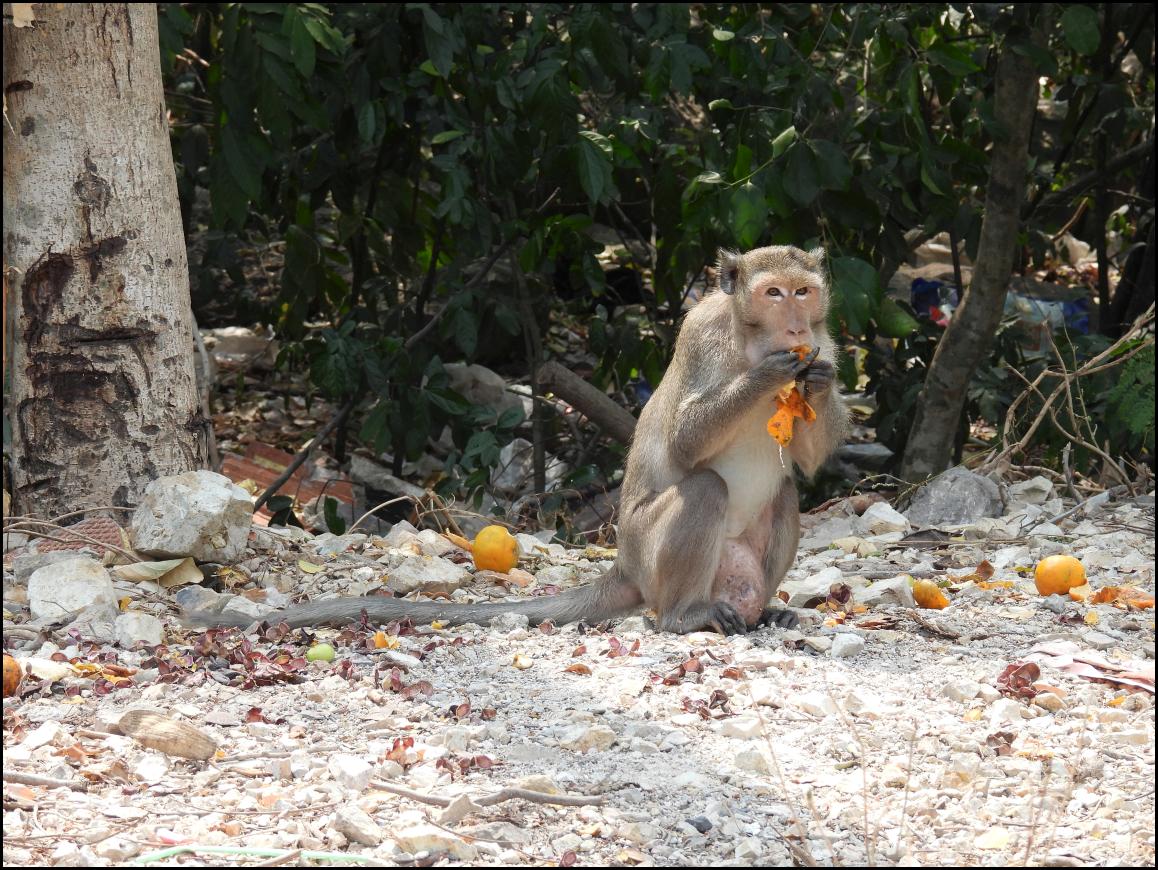
Long-tailed Macaque
We moved on to the Bang Kum area, we had 5 RED-WATTLED LAPWINGS, 3 BRONZE-WINGED JACANAS, 2 Brown Shrikes, an Indochinese Roller, a White-breasted Kingfisher, 2 Black Drongos, 20 Asian Openbills and another Purple Heron. A little further to Bang Chak we had a brief ASIAN GOLDEN WEAVER, male and female Amur Stonechats, a White-breasted Waterhen, 2 Blue-tailed Bee-eaters and a Plain Prinia. We also spent a while watching two harriers hunting. After taking photos and a bit of discussion Peter deduced that they were both Eastern Marsh Harriers. The final lifer of the day was a flock of 30 EASTERN CATTLE EGRETS and a large Water Monitor was on the road.
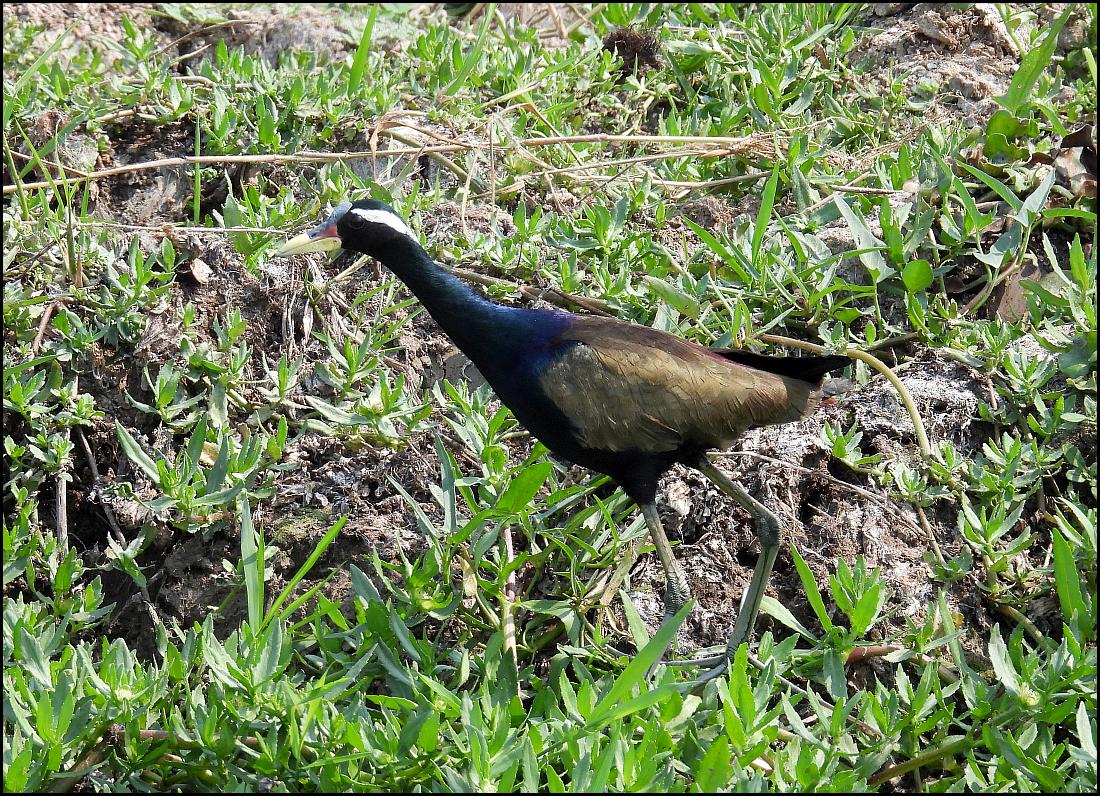
Bronze-winged Jacana
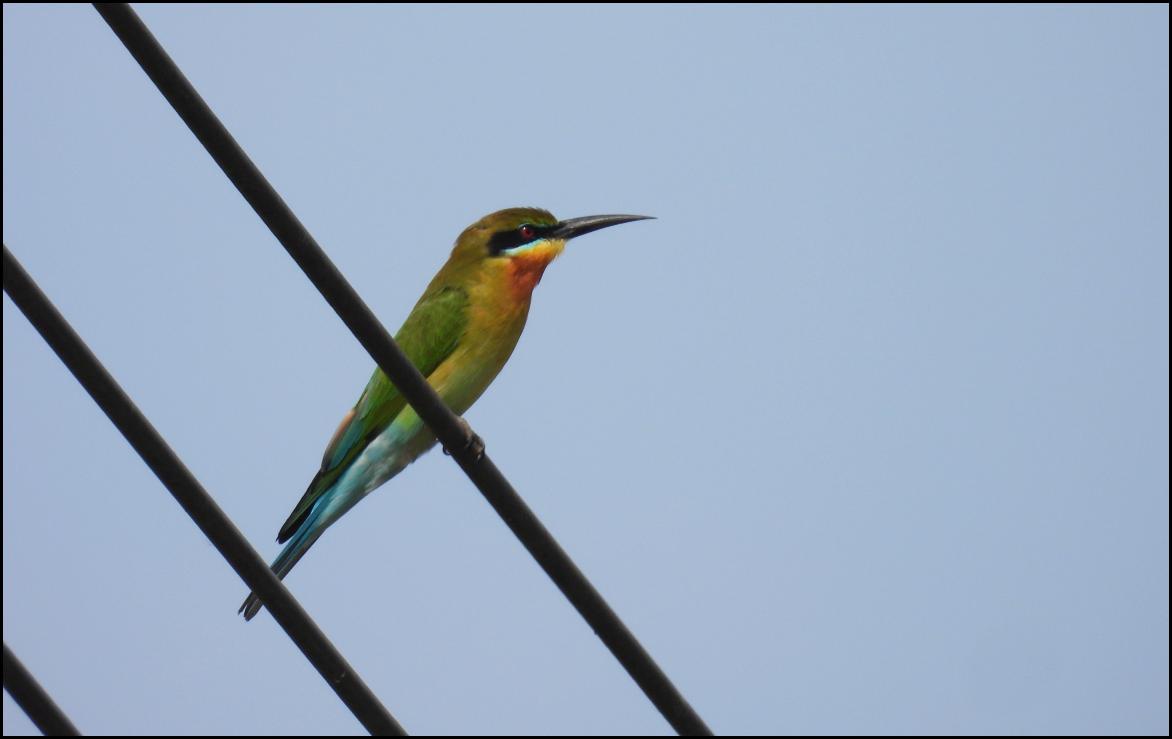
Blue-tailed Bee-eater
Peter dropped us off at the Sun Hotel in Phetchaburi, the one-night stay cost £16. It was the perfect place to stop over before moving on to Baan Maka in the morning. Peter was an excellent guide and good company. He delivered on Spoon-billed Sandpiper and so much more. I can thoroughly recommend him if you need a guide in Thailand. Many thanks Peter.
We had a meal in the restaurant next door to the hotel, then got an early night as it had been a full-on tiring day.
Day 6 – February 19th – Welcome to the Jungle
As usual I was up before sunrise and went for a short pre-breakfast walk. There was plenty to see but most were now becoming common birds to me. The best was my first ASIAN GREEN BEE-EATER. Also, of note 2 Ashy Woodswallows and a Long-tailed Macaque on the top of a shopfront.
After breakfast, our pre-booked transport arranged with Baan Maka Lodge picked us up at 8am (THB 1500 £34). On the short journey we saw a huge flock of 200+ Eastern Cattle Egrets and a White-throated Kingfisher, the only species of kingfisher seen so far.
We checked in at the lodge, as we were early our chalet wasn’t ready, which we expected, so went birding in the grounds. Here there was a whole new range of birds to get to grips with. A male WHITE-RUMPED SHAMA was sat on the Nature Trail sign and a Malaysian Pied Fantail followed us around our feet at the start of the trail. I’m not sure why but we decided to climb to the top of the 500m loop trail around the hill at the back of the lodge. It was very steep, through mainly bamboo forest, and extremely hot. There were splendid views from the top but the only birding rewards were 2 HIMALAYAN SWIFTLETS at the summit and a CHESTNUT-HEADED BEE-EATER at the base.
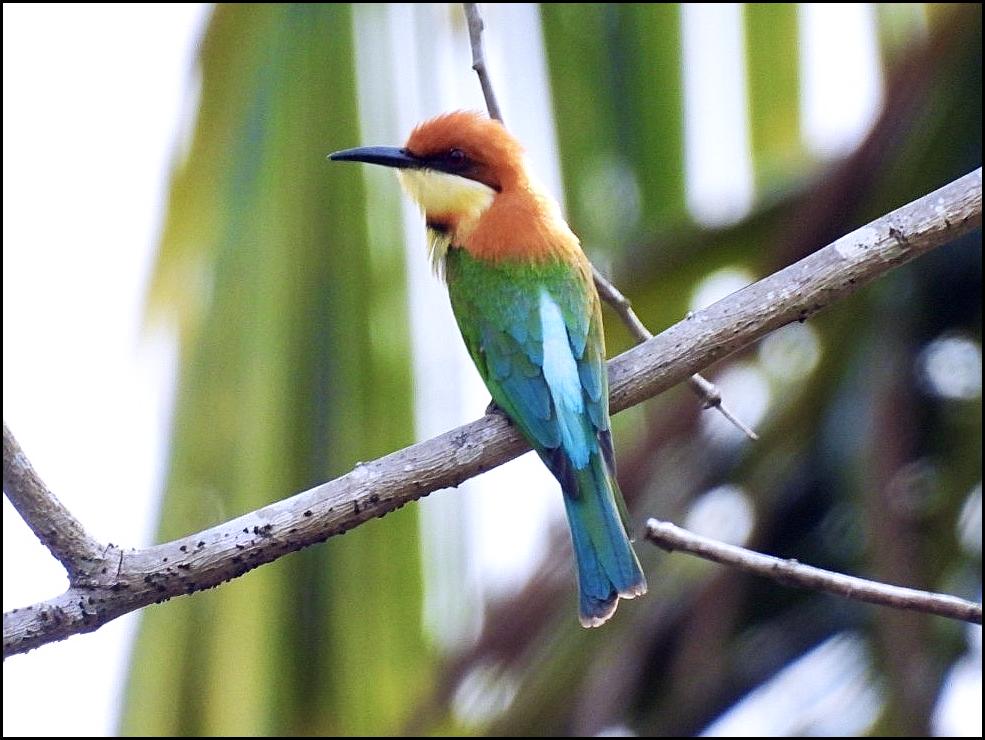
Chestnut-headed Bee-eater
Back at the lodge we ordered fruit smoothies and birded from the shade. There was plenty to see including a BLUE WHISTLING THRUSH, a GREATER NECKLACED LAUGHINGTHRUSH, a PUFF-THROATED BABBLER, a fabulous GREATER RACKET-TAILED DRONGO with long tail streamers and a STRIPE-THROATED BULBUL. Also 6+ GREY-BELLIED SQUIRRELS and a HIMALAYAN TREE SQUIRREL darted all over the place. Our chalet was now ready and we settled in. It was good to unpack for a few days. The chalet was light, with air conditioning and a perfect base.
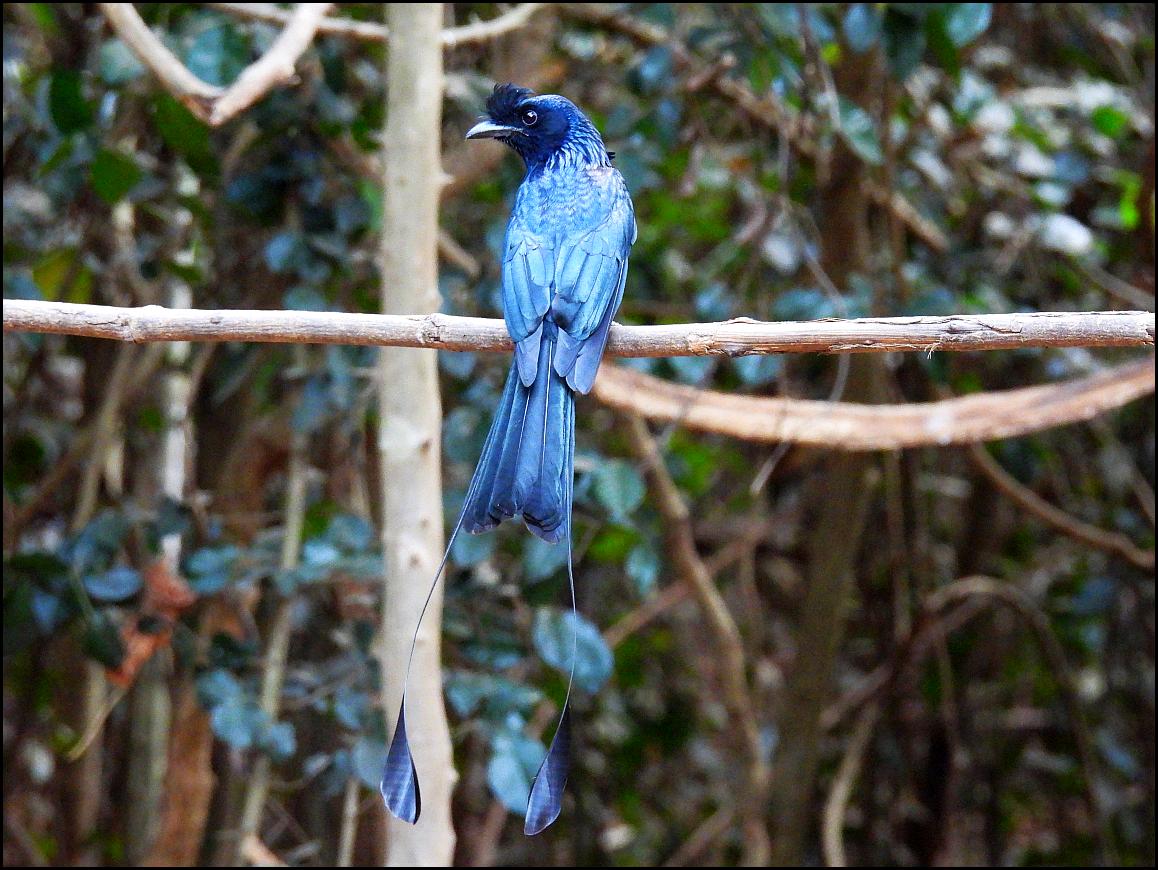
Greater Racket-tailed Drongo
We headed back out, first to the lake, 5 Moorhens were trip ticks and an Asian Brown Flycatcher, and a Greater Coucal was notable, a Water Monitor was cooling in the shallows. We moved on to the Garden Trail, where we met a German couple who showed us a close CRESTED HONEY-BUZZARD. There were plenty of birds in the gardens including 2 SOOTY-HEADED BULBULS, 2 BLACK-CRESTED BULBULS, 14 Red-wattled Lapwings and an Indochinese Roller. Bridgette sat in the shade whilst I explored some more. I found a PLAINTIVE CUCKOO in the allotments, and in a cool shaded forest edge a PIN-STRIPED TIT BABBLER and a pair of dazzling blue BLACK-NAPED MONARCHS. A Water Monitor on the path gave me start.
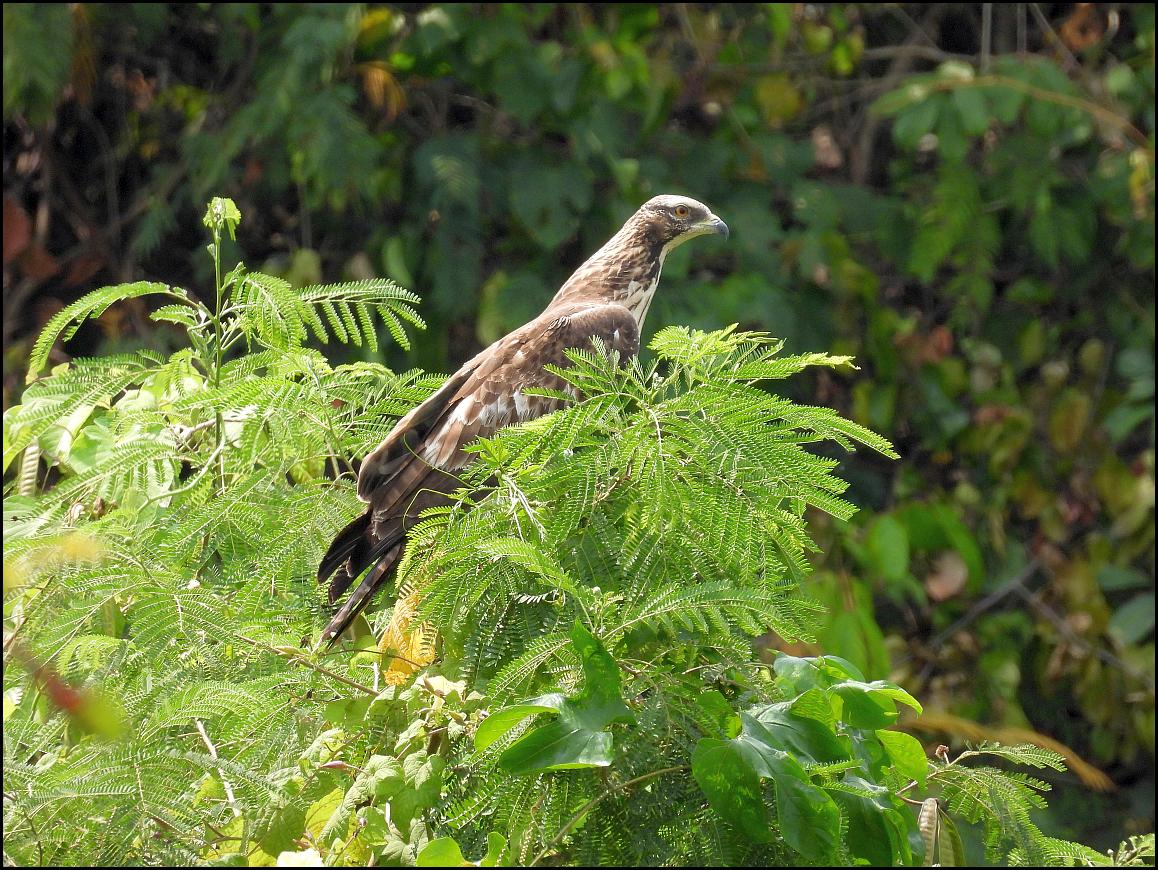
Crested Honey-Buzzard
Bridgette went back to the chalet out of the heat, I stayed out. High in the forest I spotted an ORIENTAL PIED HORNBILL, unmistakable and a great bird to get. I tracked back through the allotments and found a Brown Shrike and 2 PADDYFIELD PIPITS. Before going back, I revisited the lake and found 6 Chestnut-headed Bee-eaters, a White-throated Kingfisher and a male RED JUNGLEFOWL. I’d seen these in the Caribbean as an introduced species but not a satisfying tick. This gorgeous male then proved its wildness by flying across the lake. I’d never seen a chicken fly before and it looked fabulous.
We rested up until 6pm then went to the main building for dinner. The food was great, which was pleasing as there were no other options out here in the middle of nowhere.
We had prebooked on a Night Walk and as dusk fell our guide, Beckham, arrived to gather the night walkers together. Walking towards the lake by torchlight, we could hear an owl calling. Beckham located it before anyone else in a palm tree; it was a COLLARED SCOPS OWL. He showed us a nearby tree where up until two days ago a King Cobra had been sleeping. Then he found a COBALT BLUE TARANTULA, the first of two in a burrow. Next was a SOUTH-EAST ASIAN TREE FROG in a small pool. Walking down the drive we could hear a different owl. It was a BROWN BOOBOOK sat on overhead wires and showing very well. Further on was another Collared Scops Owl, only not so co-operative. A PANTROPICAL HUNTSMAN SPIDER was on the road. We walked around and into the garden through the back entrance. We found a small PAINTED BRONZEBACK SNAKE up a tree. A couple of ASIAN COMMON TOADS were on the path, a SPOT-LEGGED TREE FROG on a leaf and a very brief Nightjar, probably Large-tailed flew off, but I missed it. The best was left until last, in the forest edge where I had been earlier, Beckham picked out a BENGAL SLOW LORIS high in the trees. It gazed down at us with huge eyes, and everyone agreed it was probably the cutest mammal they’d ever seen. We were incredibly lucky as it wasn’t seen on any other Night Walk whilst we were there. On the way back through the chalets a smart TOKAY GECKO was giving its loud onomatopoeic call – listen here. Finally, after saying goodnight to everyone a Flat-tailed House Gecko was on our porch to greet us.
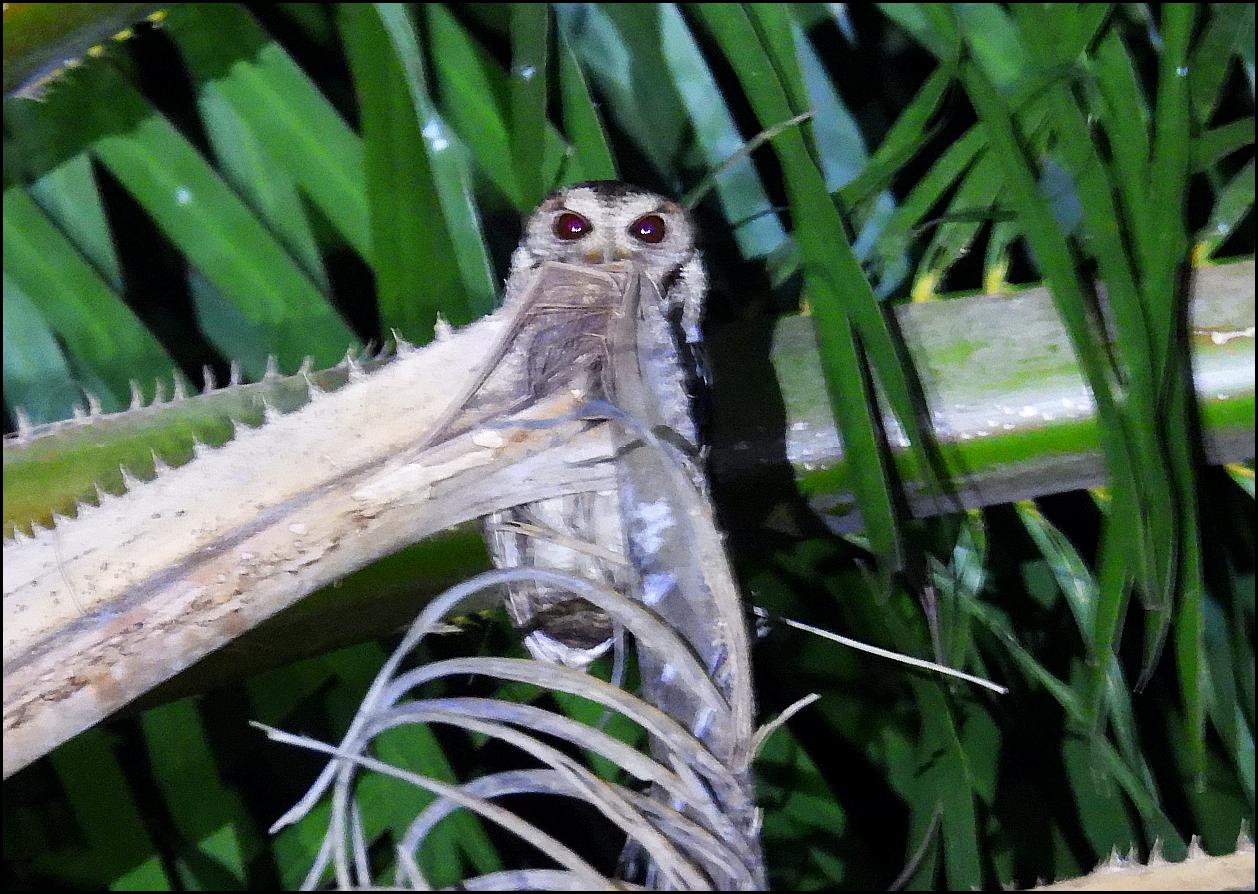
Collared Scops Owl
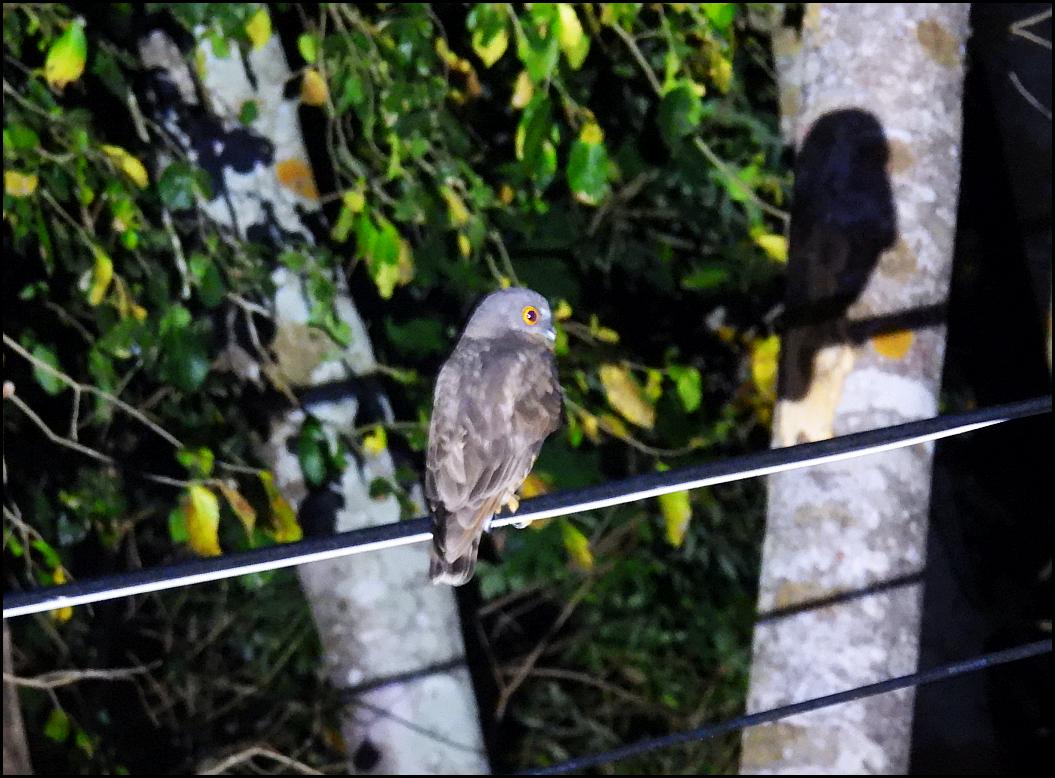
Brown Boobook
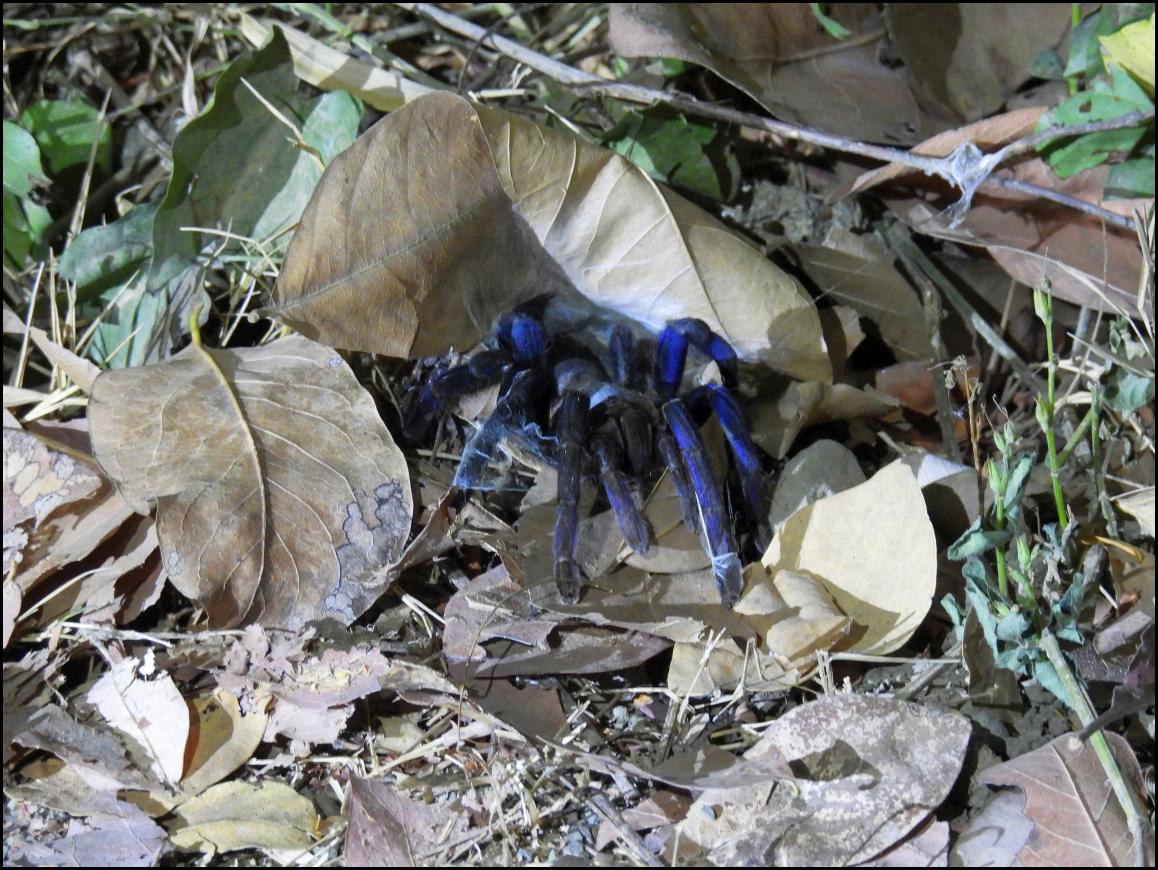
Cobalt Blue Tarantula
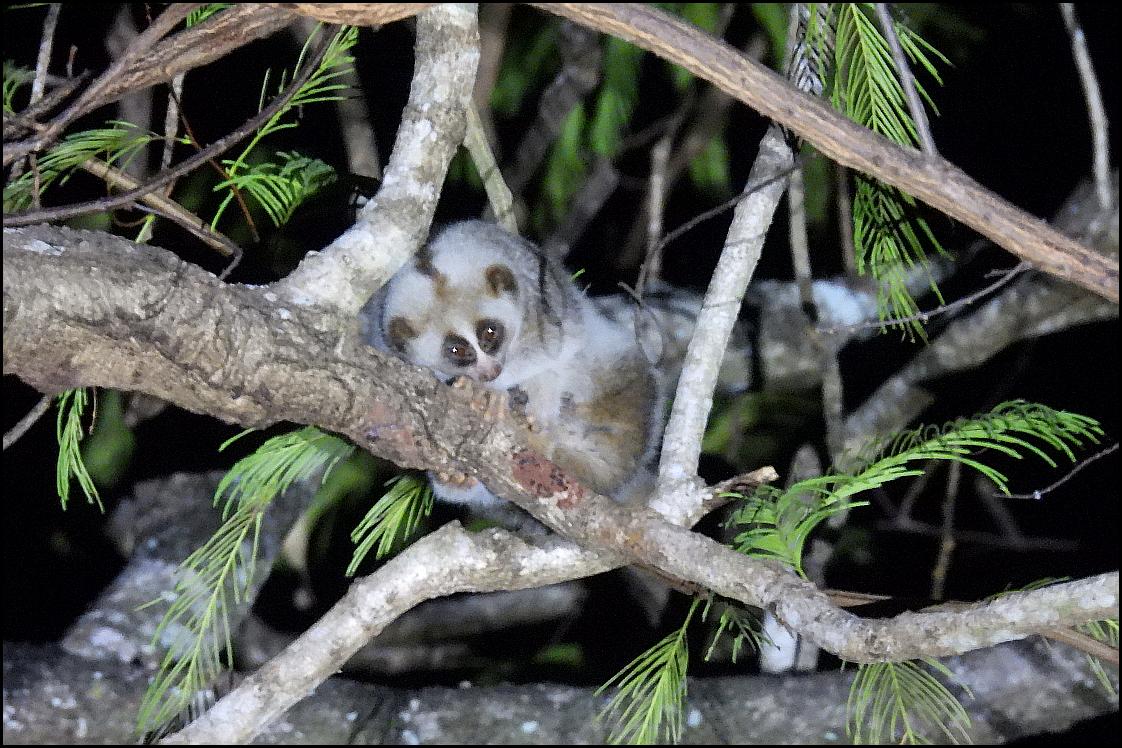
Slow Loris
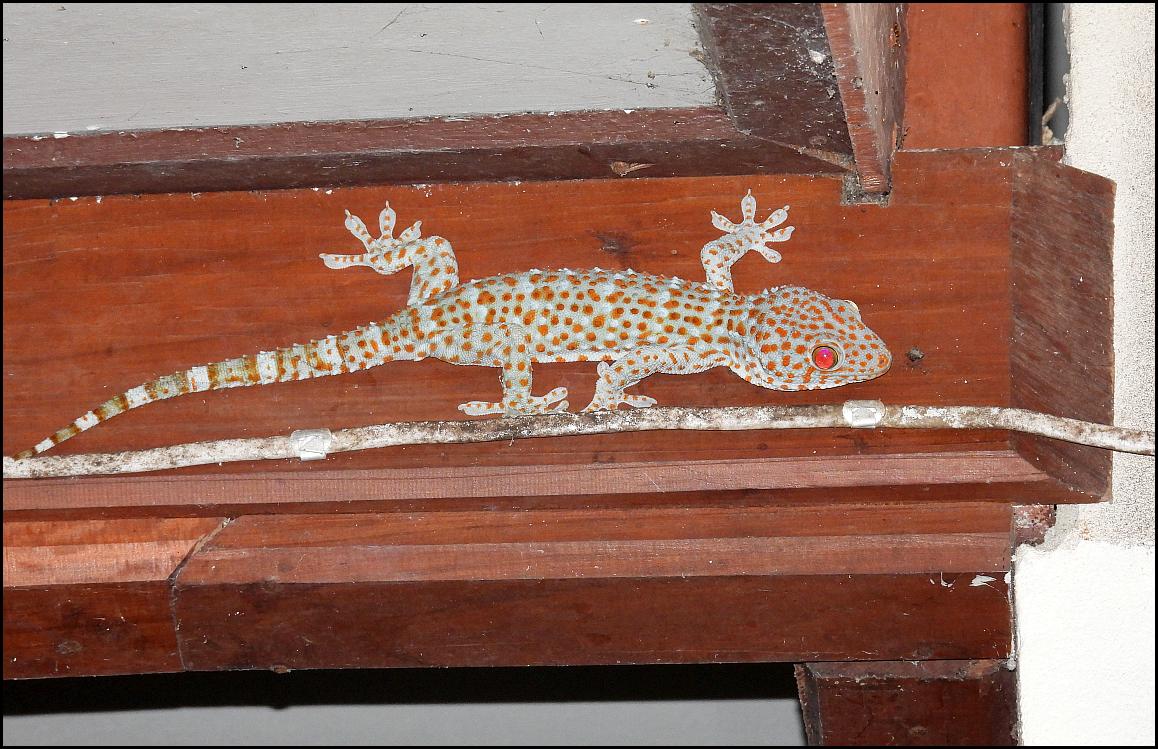
Tokay Gecko
Day 7 – February 20th – Kaeng Krachan N.P. Day 1
We were up for a 5:30am breakfast and our guide for the next day and a half, Piak, was waiting for us. He introduced himself and were whisked away in the darkness in his 4×4 towards Kaeng Krachan N.P. You don’t get to the top of the mountain unless you are in a 4×4, there are streams to cross and some rough and difficult vertical roads. We stopped at the entrance and paid our entrance fees of THB 300 (£6.85) each. As we entered the park a LARGE-TAILED NIGHJAR flew up from the road giving only a brief view.
We stopped with several other vehicles overlooking a valley, which was a hotspot for Hornbills. As dawn broke Piak pointed out 6 TICKELL’S BROWN HORNBILLS, also known as Rusty-cheeked Hornbill and 10+ Oriental Pied Hornbills. There were two woodpeckers, a GREATER YELLOWNAPE flew over, not the best views but we would see it better later and a GREATER FLAMEBACK showed well, and also an INDIAN HILL MYNA. The format for the day was drive and stop and in and out of the vehicle continuously, although we did get to walk occasionally, and Piak knew all the best stops.
The next stop we had 2 WEDGE-TAILED GREEN PIGEONS, 2 Indochinese Rollers, 4+ STUMP-TAILED MACAQUES and a Crested Honey-Buzzard. A little further on was a Crested Serpent Eagle and an ORIENTAL DOLLARBIRD. We stopped for a party of DUSKY LANGURS, the first of many, and 10 HAIR-CRESTED DRONGOS.
At a river crossing a COMMON EMERALD DOVE was having a drink and just around the corner an adult and a juvenile FEA’S MUNTJAC were beside the track. They were larger and redder than our familiar Muntjacs.
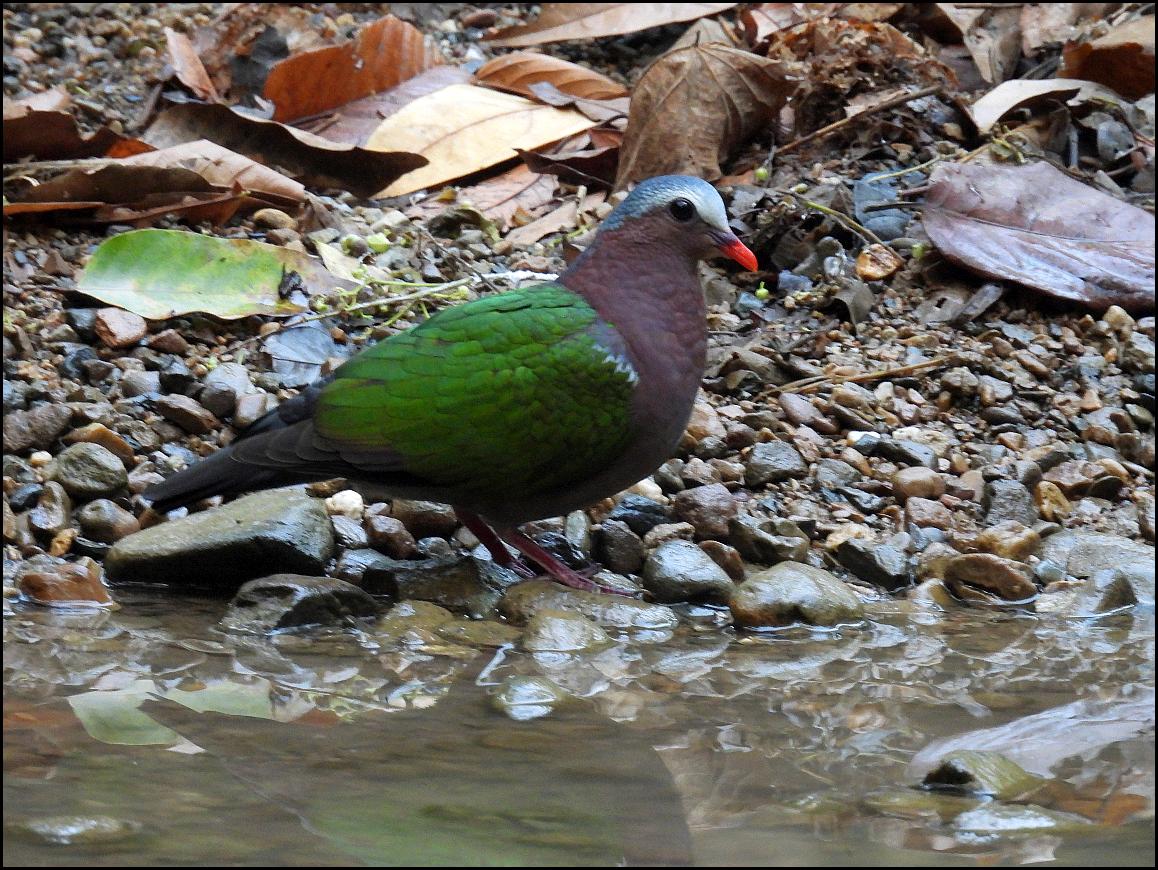
Common Emerald Dove
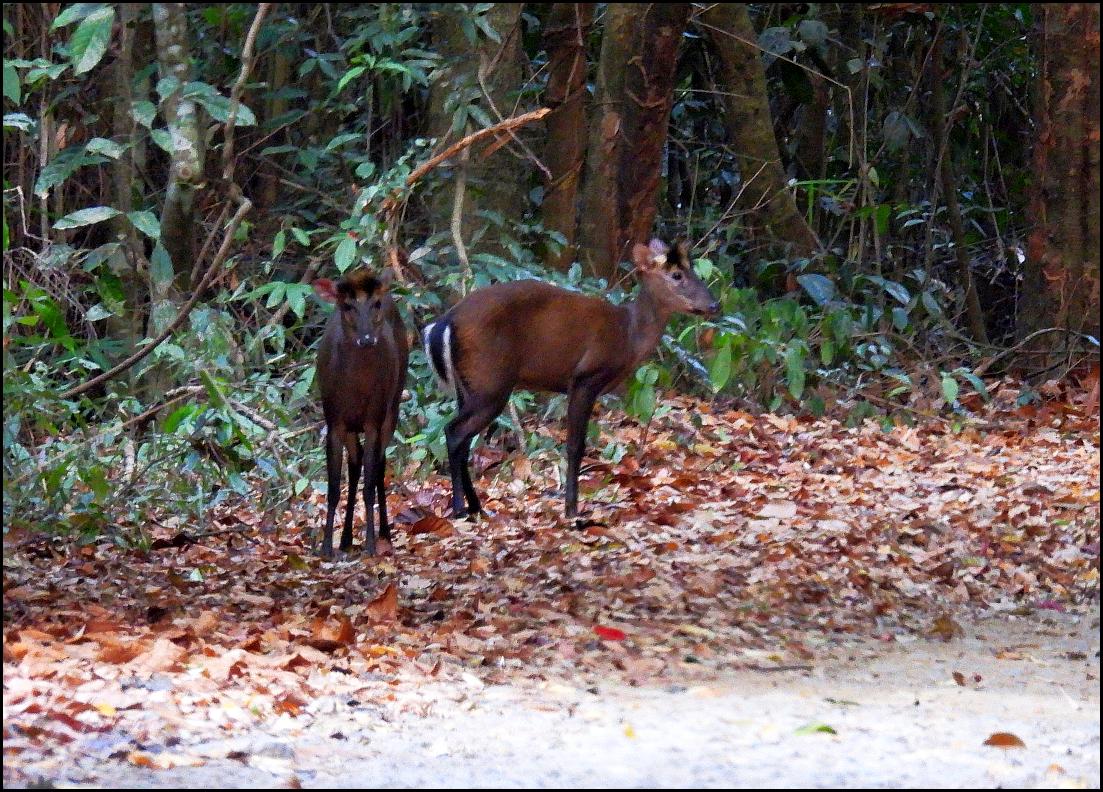
Fea’s Muntjac
Higher up the hill we stopped for a pair of scarce, WHITE-CROWNED HORNBILLS, I’m sure it was the only pair in the park. Whilst all hornbills are quirky, these two were surely designed by Jim Henson, with their flamboyant white feathers they looked fantastic.
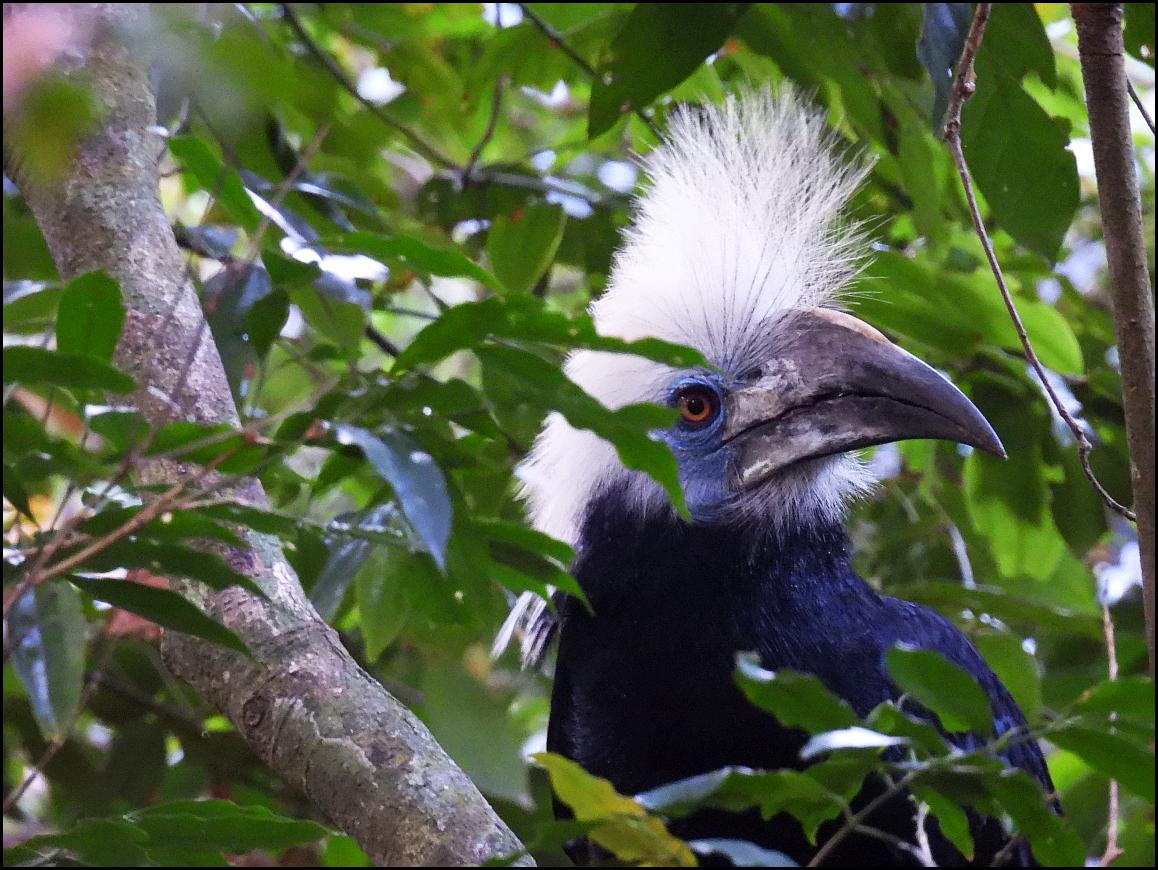
White-crowned Hornbill
We stopped for a small party of the critically endangered RAFFLE’S BANDED LANGURS. At a toilet stop at the top of the hill we saw our first Thai Radde’s Warbler. It was great to see one in its natural habitat. We walked up to Panoen Thung scenic viewpoint with panoramic views of Myanmar. Here we added House Swift, FLAVESCENT BULBULS, Grey Wagtail, a stunning HILL BLUE FLYCATCHER and a gorgeous, RED-BEARDED BEE-EATER. On the descent Piak found an OLIVE-BACKED WOODPECKER, a rare species in Thailand. White-handed Gibbons were calling nearby but we couldn’t see them here.
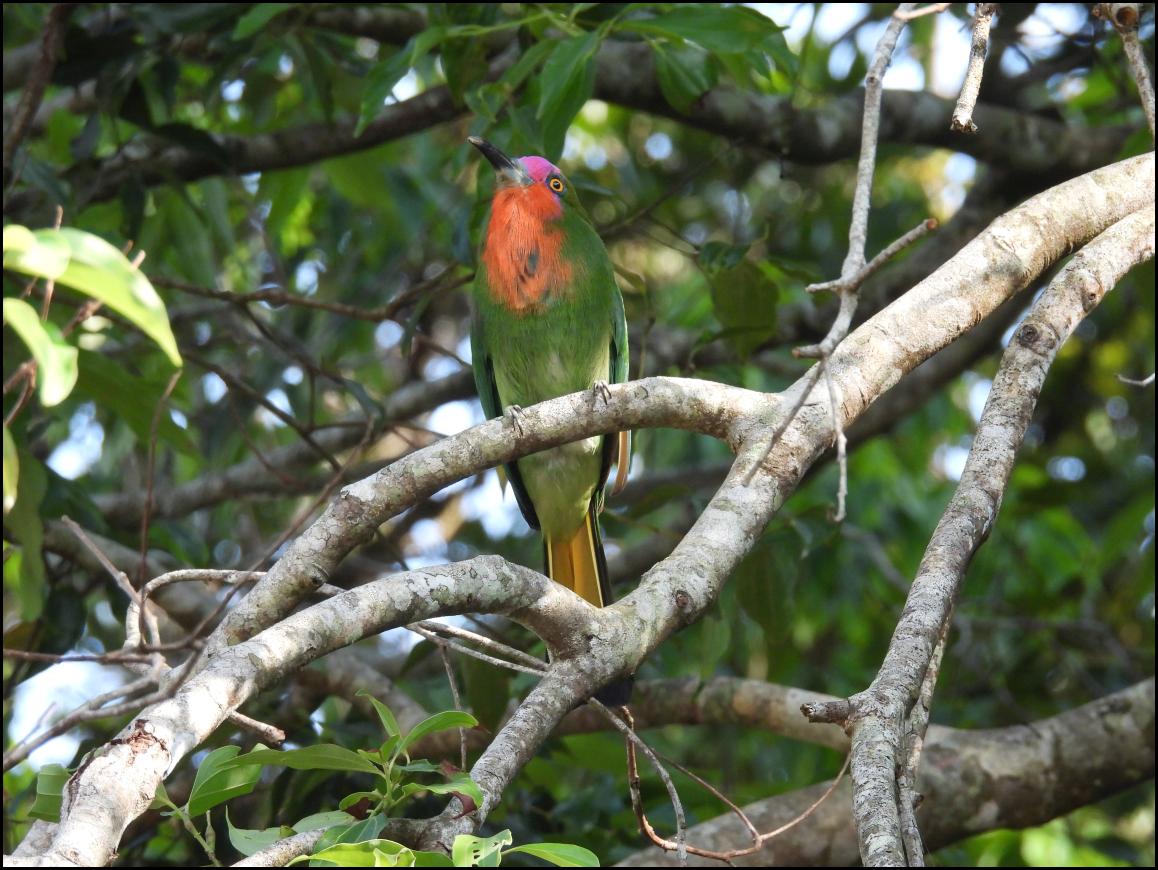
Red-bearded Bee-eater
For the next couple of hours new trip birds and lifers came thick and fast, it was wonderful here and close to an avian overload. We added BLUE-EARED BARBET, YELLOW-BELLIED WARBLER, HUME’S WHITE-EYE, BLUE-WINGED LEAFBIRD, SULPHUR-BREASTED WARBLER, BLACK-THROATED SUNBIRD, ALSTRÖM’S WARBLER (Plain-tailed) and BLUE-THROATED BARBET. We also saw 2 WHITE-HANDED GIBBONS, also known as Lar Gibbons, crashing through the treetops.
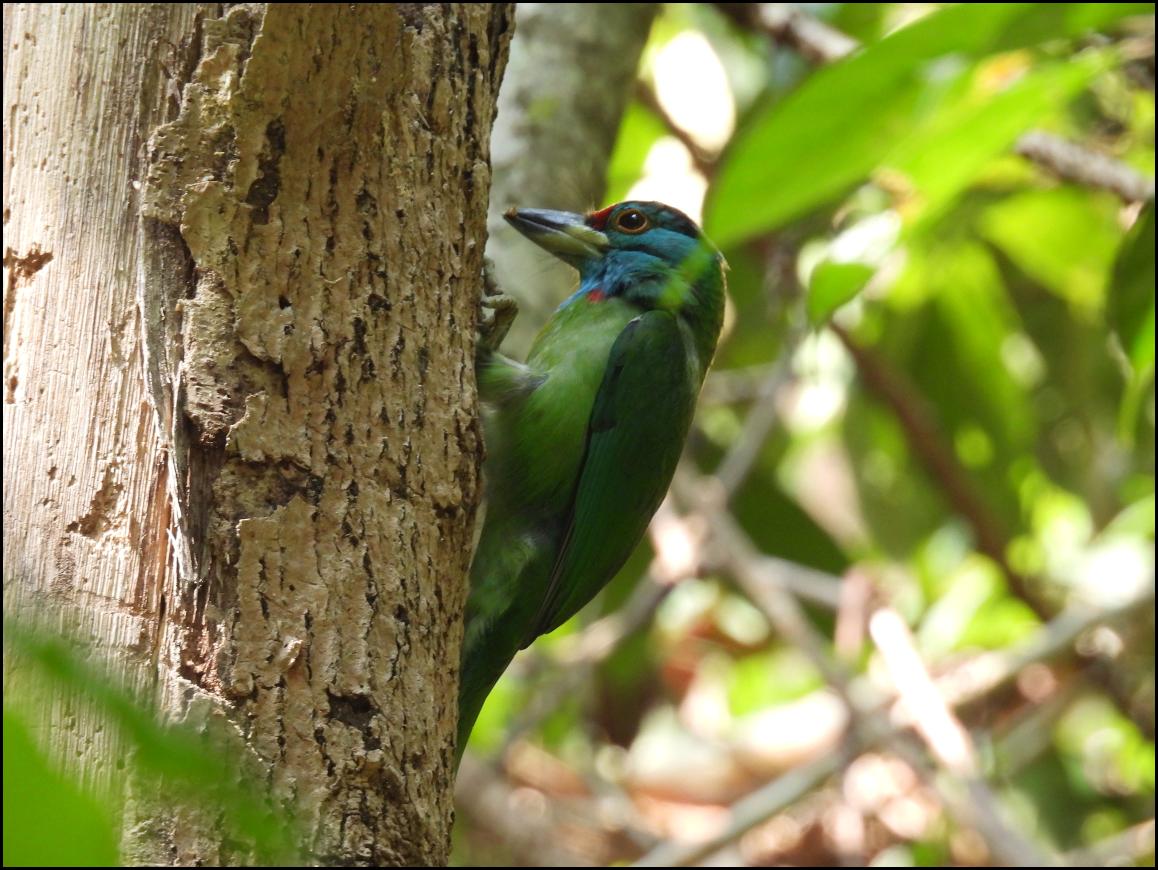
Blue-throated Barbet
We drove back to the top of the hill for lunch at a café run by a local family. Piak took care of ordering, and we were served with fried rice topped with an omelette and a soda. We sat at a very rustic table overlooking the forest enjoying our meals. Then Piak excitedly said “Look, Marten.” I was thinking “Who’s Martin?” when a beautiful YELLOW-THROATED MARTEN appeared right in front of us. I scrabbled for my camera and managed a couple of shots. What a bonus!
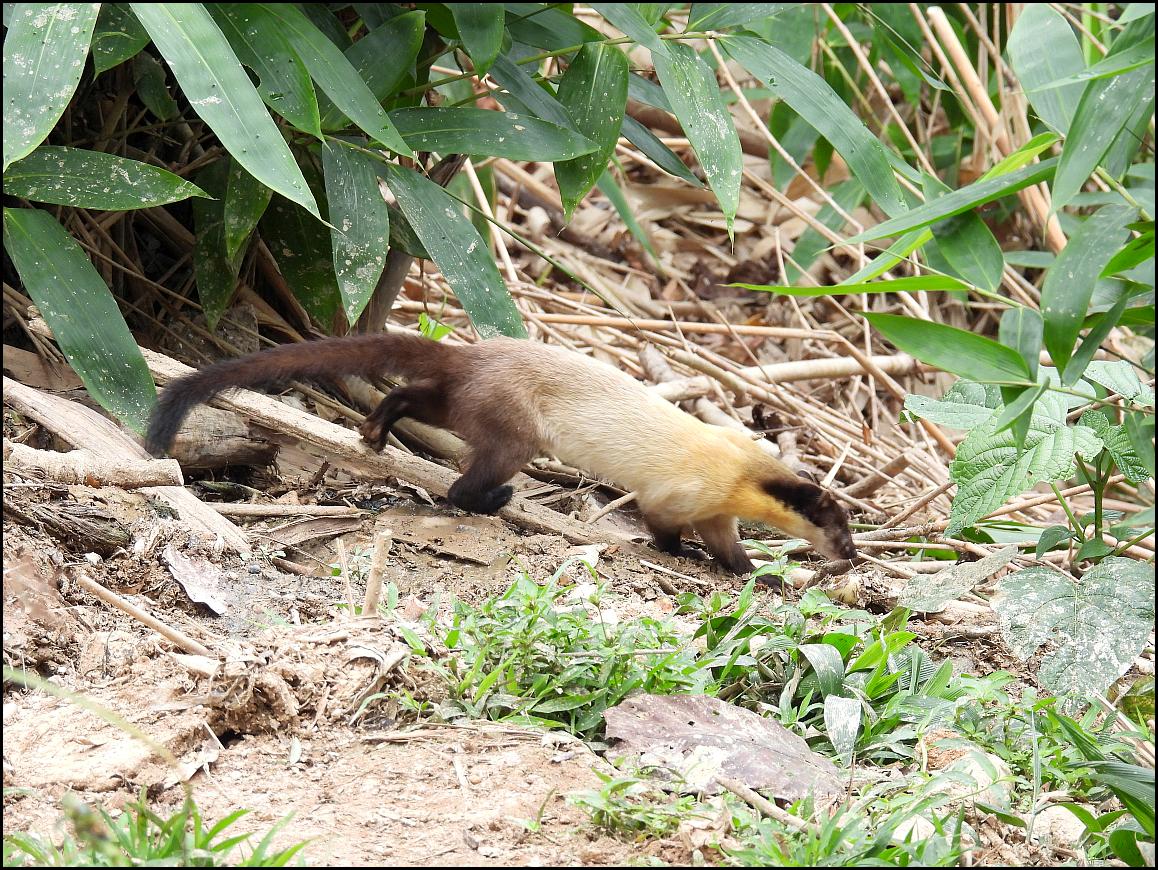
Yellow-throated Marten
After lunch we set off down the hill again stopping to bird at regular intervals. Yet more species were added to the trip list including WHITE-RUMPED MUNIA, a pair of RED-HEADED TROGONS, INDOCHINESE BLUE FLYCATCHER, SPECKLED PICULET, a tiny woodpecker, 2 lovely SILVER-BREASTED BROADBILLS, which steadfastly avoided my camera, GREY-HEADED CANARY-FLYCATCHER, BAR-WINGED FLYCATCHER-SHRIKE and Taiga Flycatcher. At one of the stops we met Shaun Robson, from the UK, who I had recently corresponded with, it’s a small world.
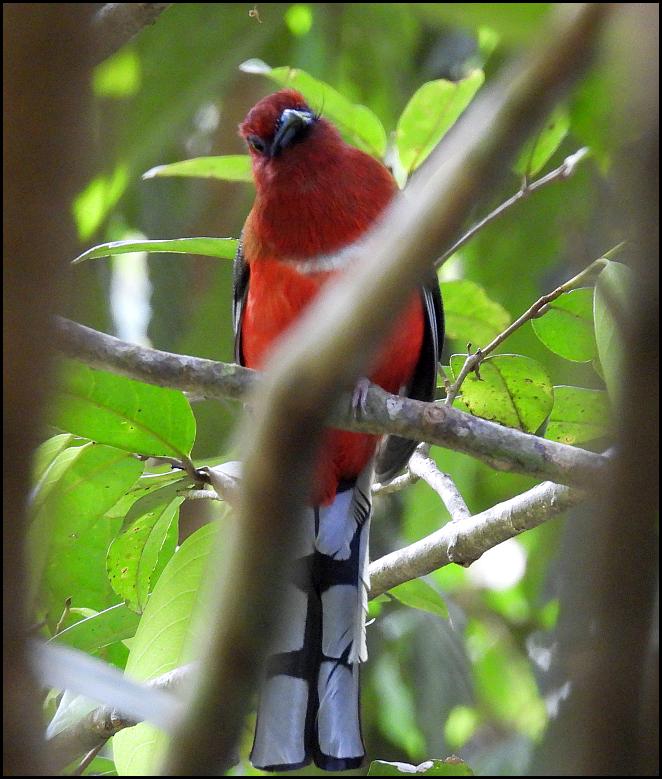
Red-headed Trogon
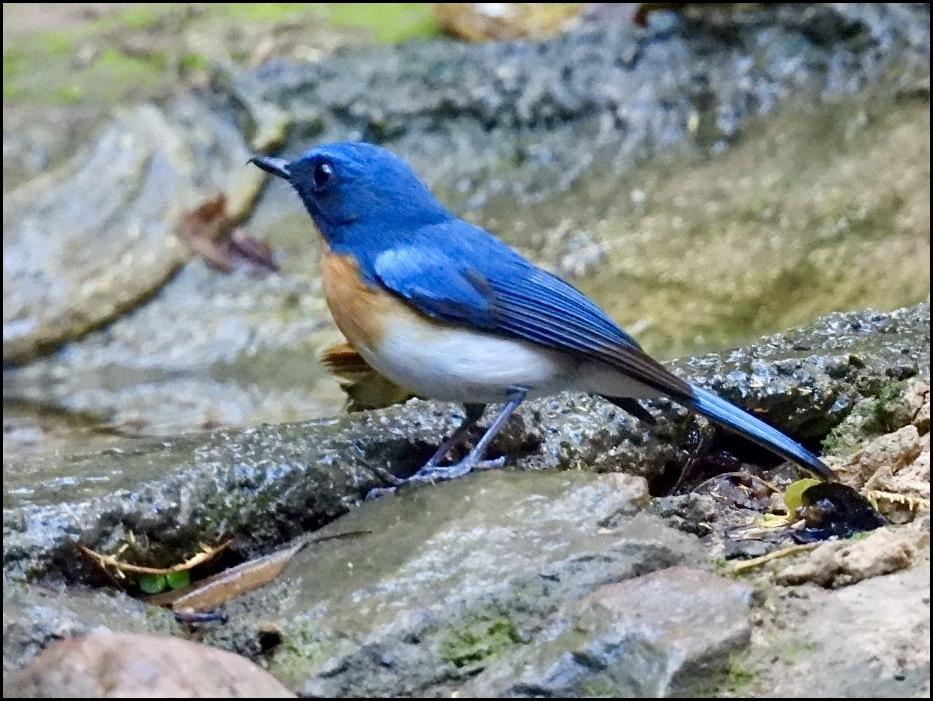
Indochinese Blue Flycatcher
The final new bird of the day was a tiny BLACK-THIGHED FALCONET high up on a treetop on a ridge above us. It had been a momentous day and Piak had been an excellent guide.
Day 8 – February 21st – Kaeng Krachan N.P. Day 2 & Bird hide
Like Groundhog Day we were up for a 5:30am breakfast and Piak was waiting for us again. We had booked half a day with him to return to Kaeng Krachan. As we left Baan Maka a Large-tailed Nightjar flew up from the road giving better views than yesterday.
We stopped at the entrance, got our tickets and drove straight to the Hornbill hotspot. There were 14 Oriental Pied Hornbills and a hugely impressive GREAT HORNBILL. This time we were walking more today and set off back down the road to search for birds. A Greater Yellownape and 4 Greater Flamebacks were in the same tree. A pair of mating Indochinese Rollers were seen, Common Tailorbird was new for the trip and Piak found a pair of beautiful BLACK-AND-RED BROADBILLS. A couple of Dusky Langurs watched us from the trees, a Brown Boobook was calling and as we returned to the car, we found 2 GREAT IORAS.
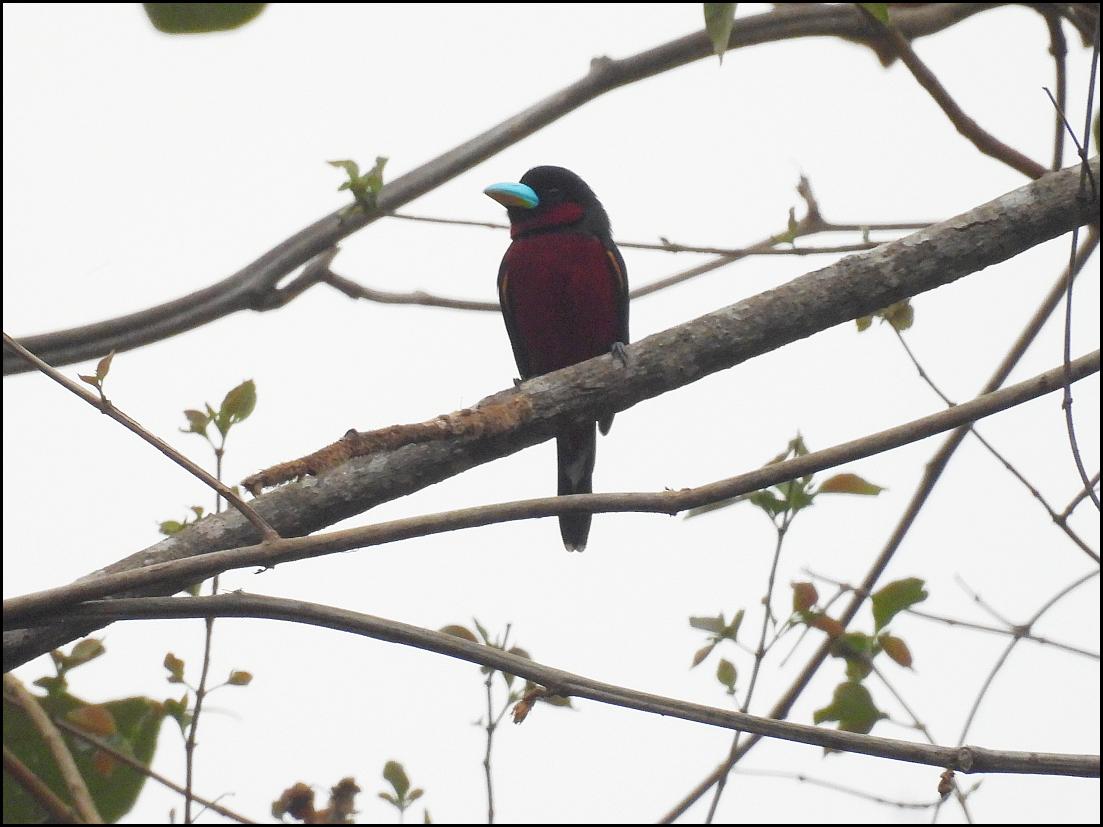
Black-and-Red Broadbill
At the next stop were 2 Chinese Pond Herons, 2 ASHY MINIVETS, 2 Grey-headed Lapwings flew over, a GREEN-EARED BARBET showed very well, an ORANGE-HEADED THRUSH, a Crested Serpent Eagle, a GOLDEN-FRONTED LEAFBIRD, an ORANGE-BREASTED TROGON and many more species already seen on the trip. It was an exciting half an hour.
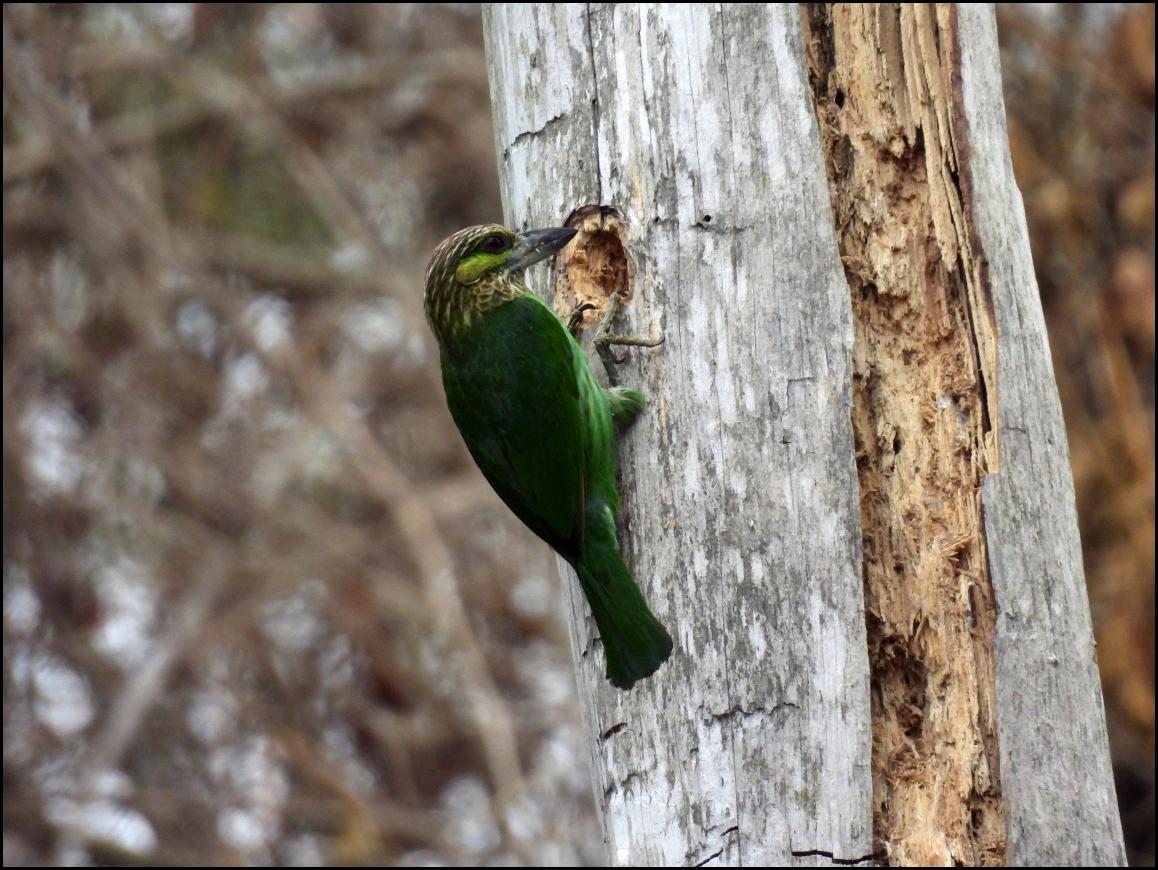
Green-eared Barbet
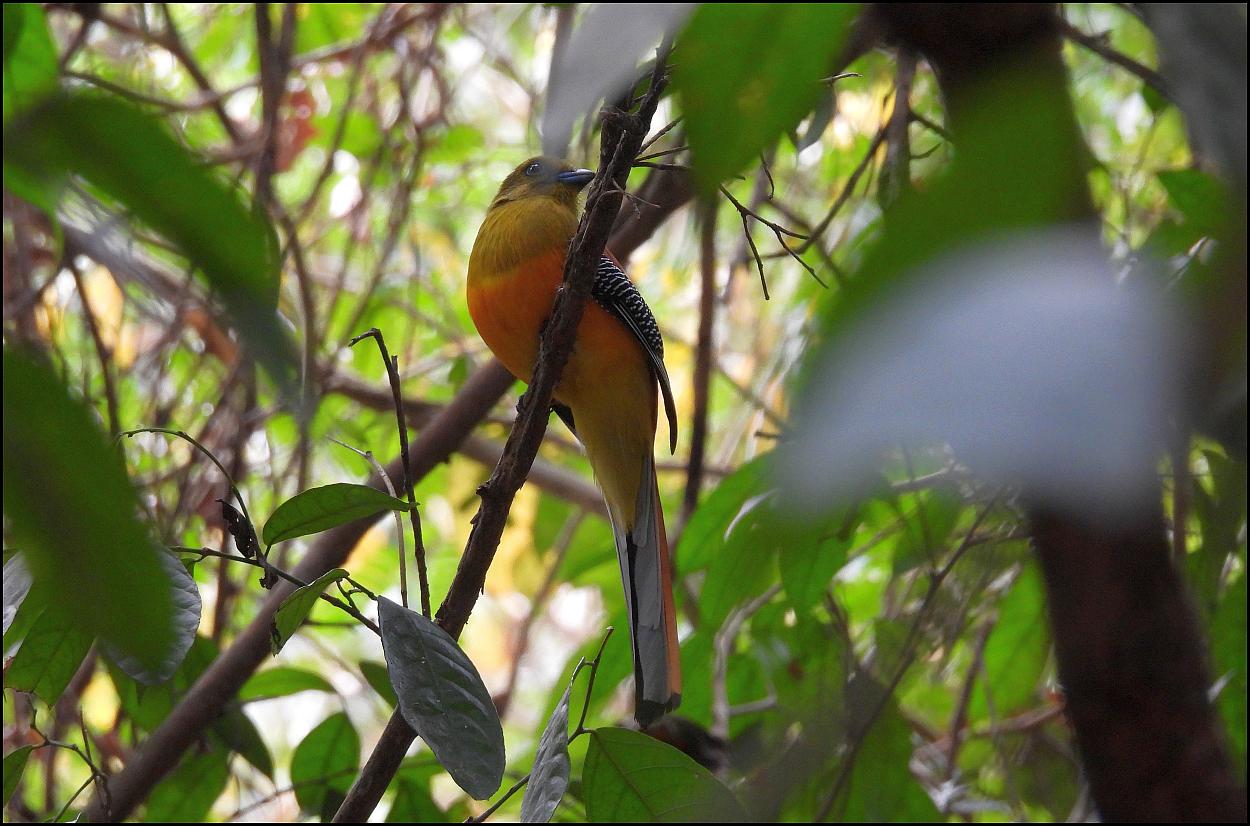
Orange-breasted Trogon
Piak drove on a little further and found a female BANDED KINGFISHER in the treetops, another great species, which was difficult to get.
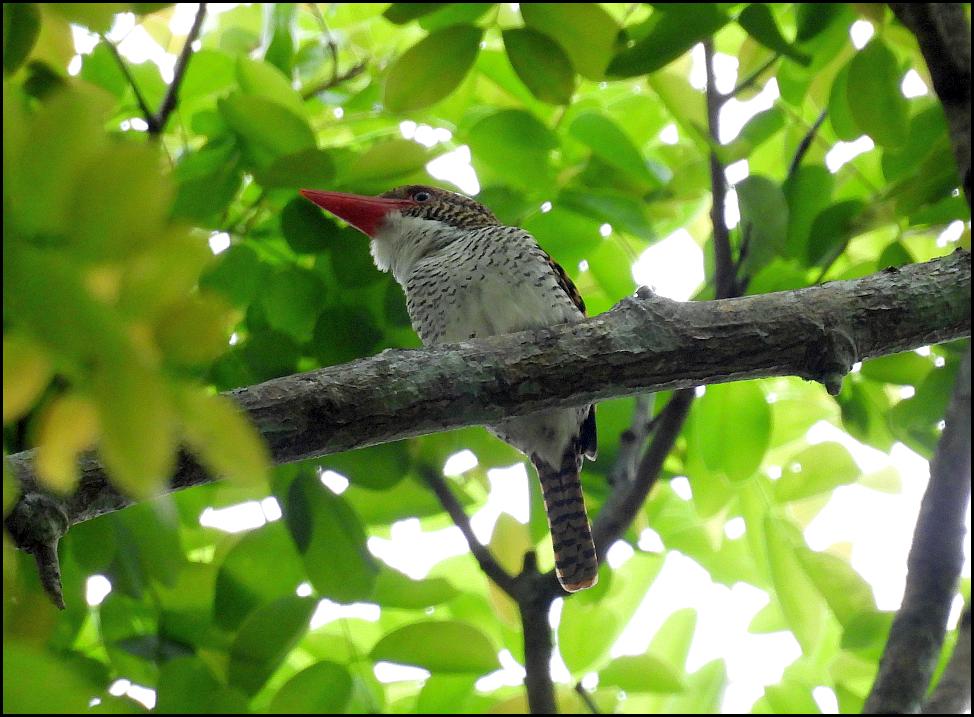
Banded Kingfisher
We took a small road out of the campsite, Piak pointed out a THICK-BILLED GREEN PIGEON, but it flew immediately so we only got flight views. I’ll have to get better views next time. We parked up and Piak searched diligently in the tops of bamboo stands eventually finding a roosting WHITE-FRONTED SCOPS OWL. This owl is endangered in Thailand, so were lucky to see it. We took a short walk into the forest seeing 2 GREY-CHEEKED BULBULS before scaling a steep path into the trees. Again, Piak searched the treetops and eventually found a roosting female SPOT-BELLIED EAGLE OWL. It was a very large owl with flamboyant ear tufts and was neck-achingly high in the trees. Also here was a close male Orange-breasted Trogon. We descended to the road and were treated to excellent views of close, White-handed Gibbons and an even closer Great Hornbill.
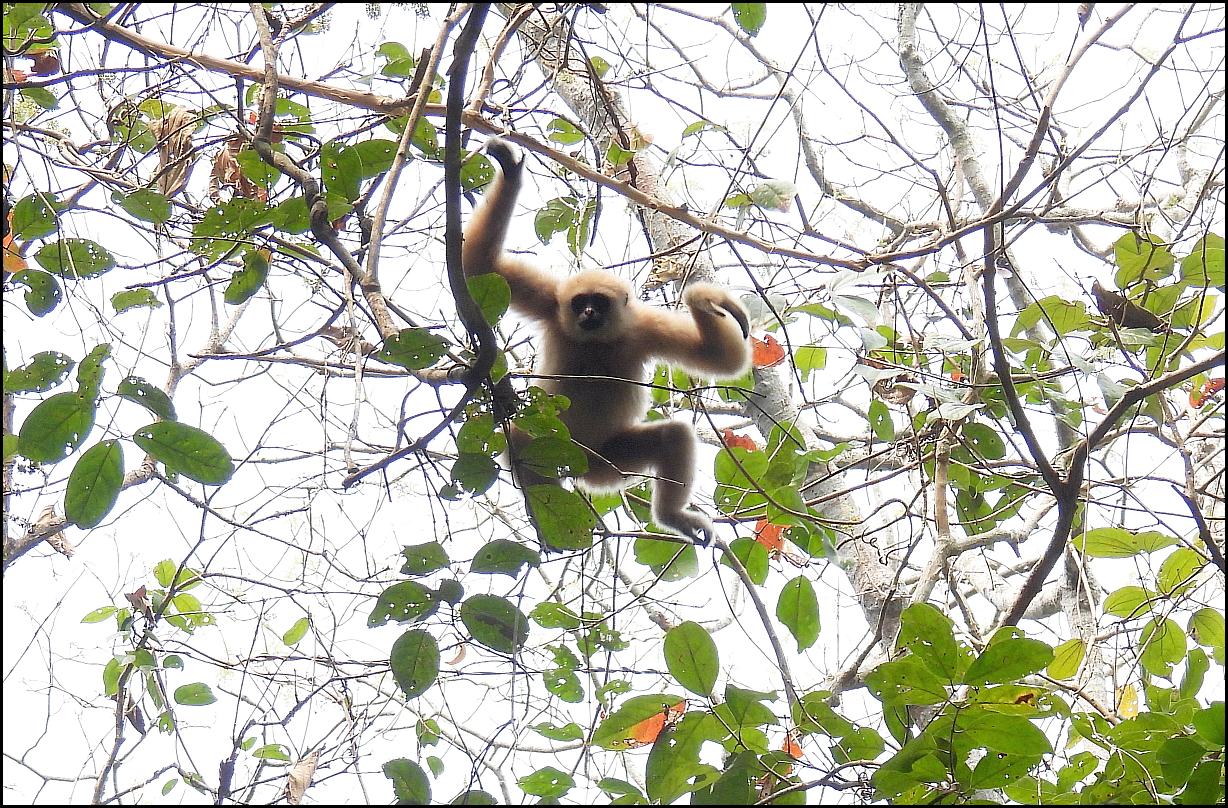
White-handed Gibbon
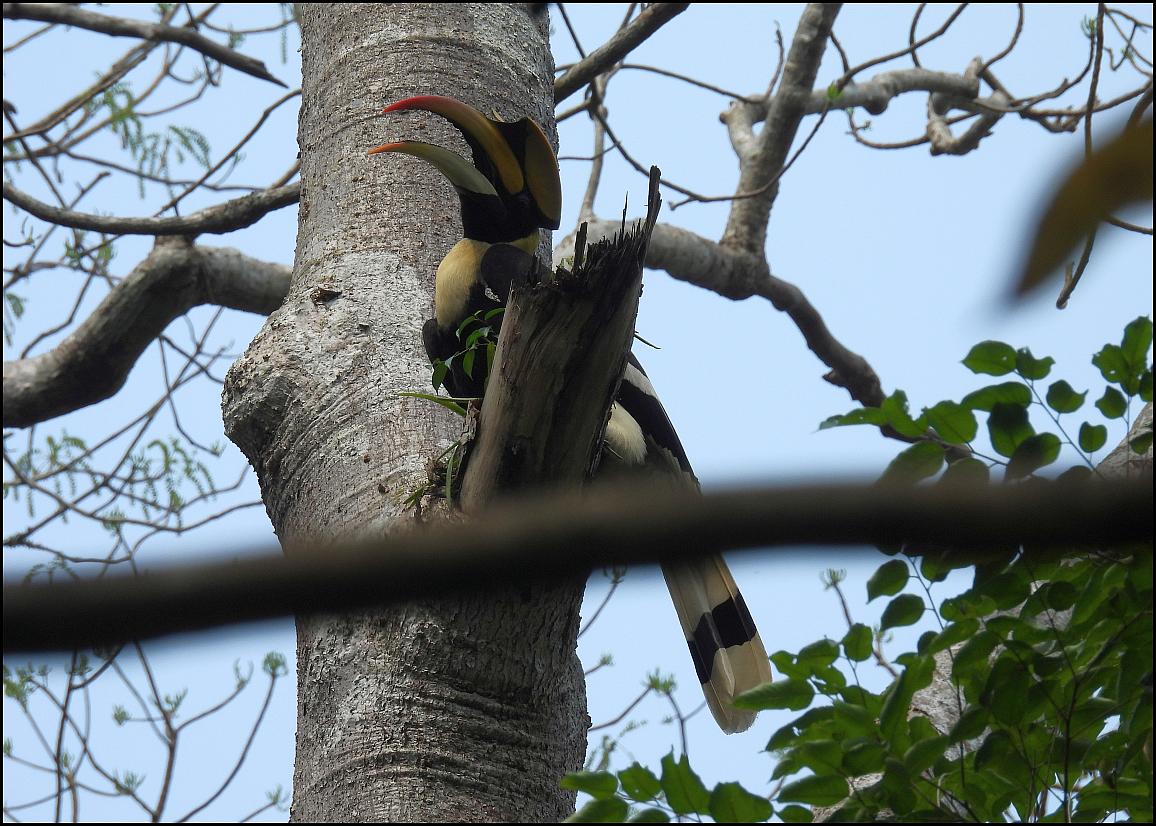
Great Hornbill
We returned to the campsite; we learnt that yesterday a Sun Bear had visited around lunchtime after a period of absence. We gave it 40 minutes, but it didn’t reappear. So ended an excellent morning with many super birds added to the trip and life lists. If you are at Baan Maka, I would recommend Piak unhesitatingly to guide you.
At lunch Bridgette was reading the information book and found we could go to local bird hides for a fee. I’m glad she reads instructions, not something men need to do. As a result, we booked a 3 hour visit to Bird’s hide (Location – 12°50’53″N, 99°31’22″E). It cost around THB 800 (£20) for both of us including transfer in a lodge vehicle.
On arrival, we were shown into the hide by “Mr Bird.” It was quite a large hide with 10 plastic chairs behind a black sacking screen with large observation holes cut in it. In front of the hide was a small pool, some loose bird food scattered around with various logs and branches in front of the forest behind. We made ourselves comfortable and settled in.
It was a constant hive of activity and what was immediately most noticeable were the squirrels. There were 2 species here Himalayan Tree Squirrels, which looked like chipmunks, and the larger, Grey-bellied Squirrels, which were more, well, squirrel-y. They were constantly on the move, feeding, drinking and sometimes squabbling.
There were the birds, and I’ll list them in order of ticking. First, I spotted a female and a juvenile robin-like species, and it took a bit of working out what they were. Had they been nice blue males it would’ve been easy, this was the fabled SIBERIAN BLUE ROBIN, a top target. It was a shame there wasn’t a male there, but I was still pleased. We got much better views of a stunning Orange-headed Thrush and a pair of Greater Yellownape woodpeckers.
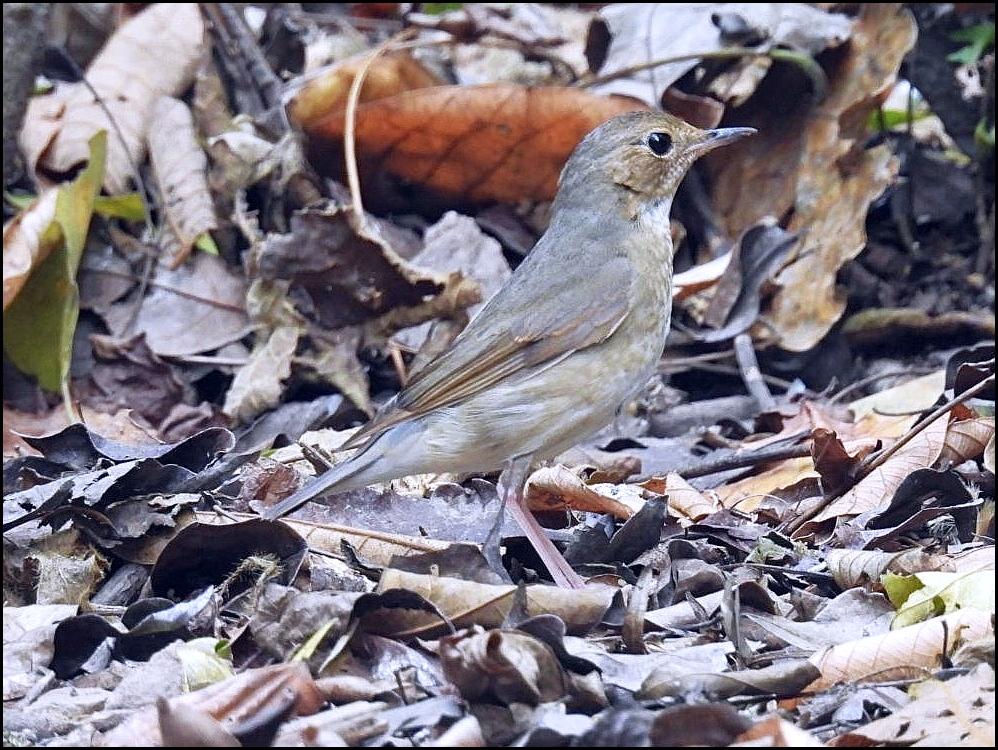
Siberian Blue Robin
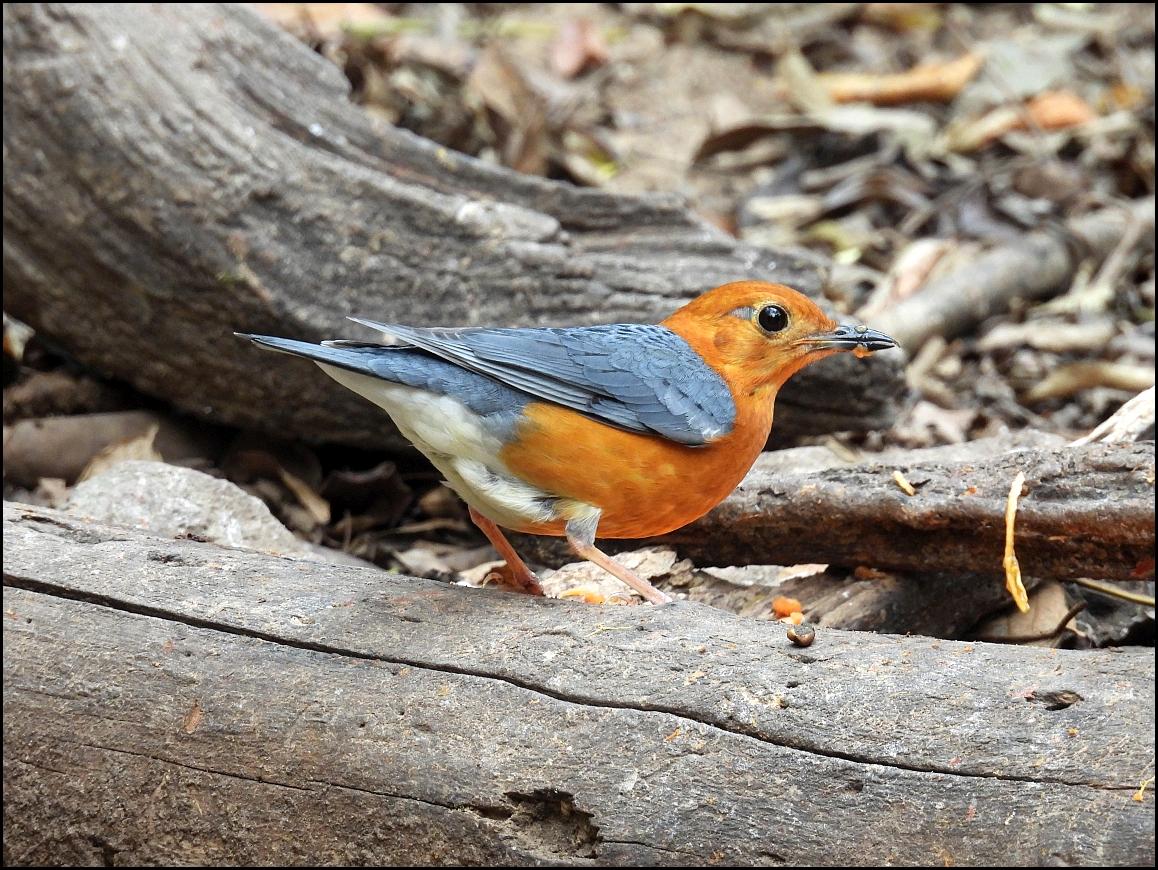
Orange-headed Thrush
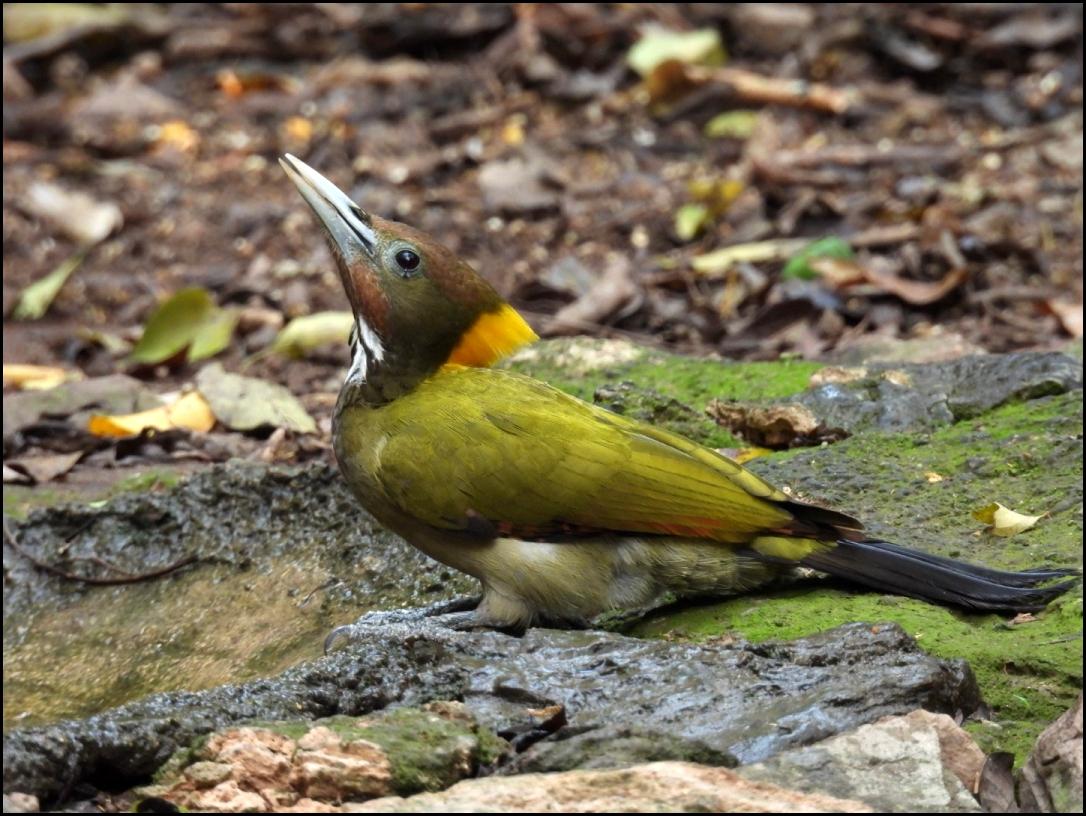
Greater Yellownape
New birds came thick and fast, 2 LESSER-NECKLACED LAUGHINGTHRUSHES, 2 WHITE-CRESTED LAUGHINGTHRUSHES, a beautiful male GREY-PEACOCK PHEASANT, 6 BROWN-CHEEKED FULVETTAS, 2 lovely orange FERRUGINOUS PARTRIDGES, a pair of KALIJ PHEASANTS, a SCALY-BREASTED PARTRIDGE, 2 BAR-BACKED PARTRIDGES, a RACKET-TAILED TREEPIE, a HAINAN BLUE FLYCATCHER and lastly a COMMON FLAMEBACK woodpecker.
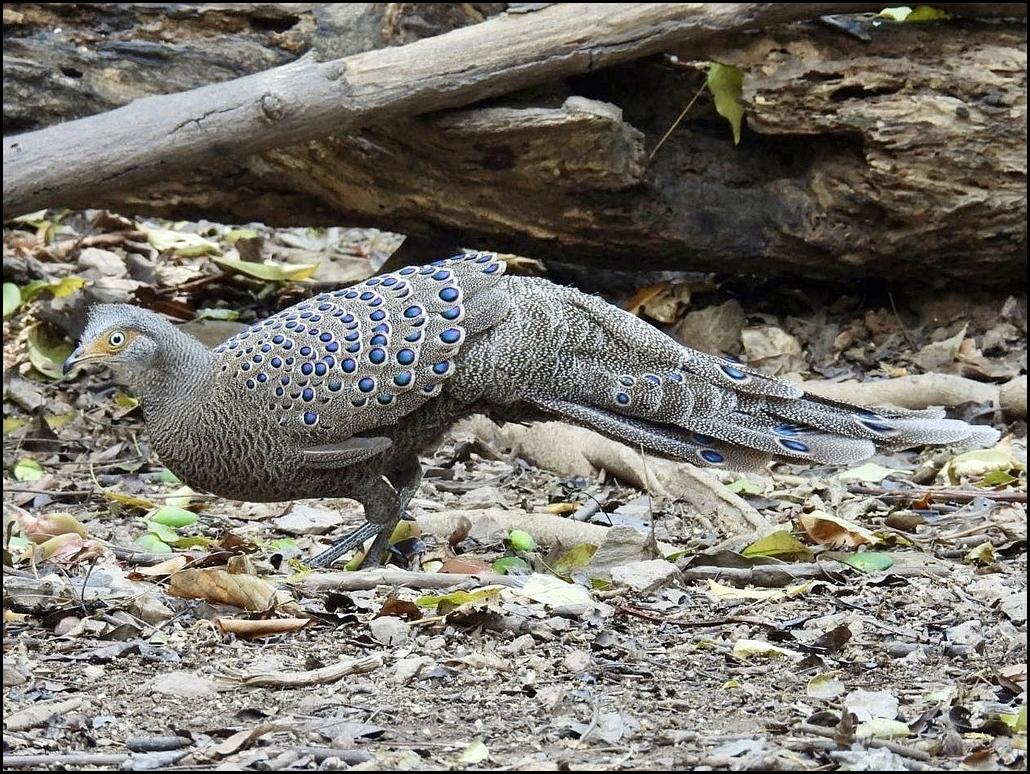
Grey Peacock Pheasant
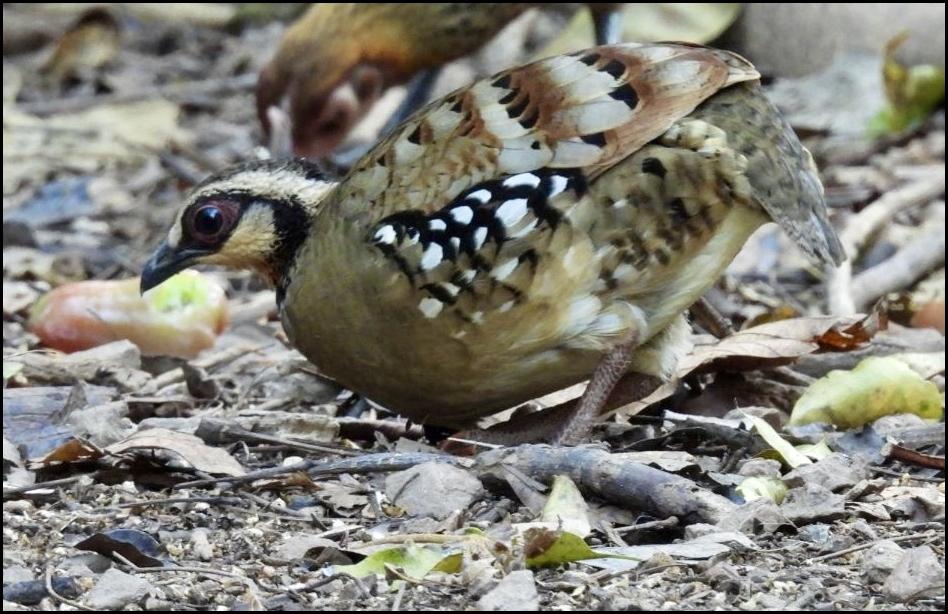
Bar-backed Partridge
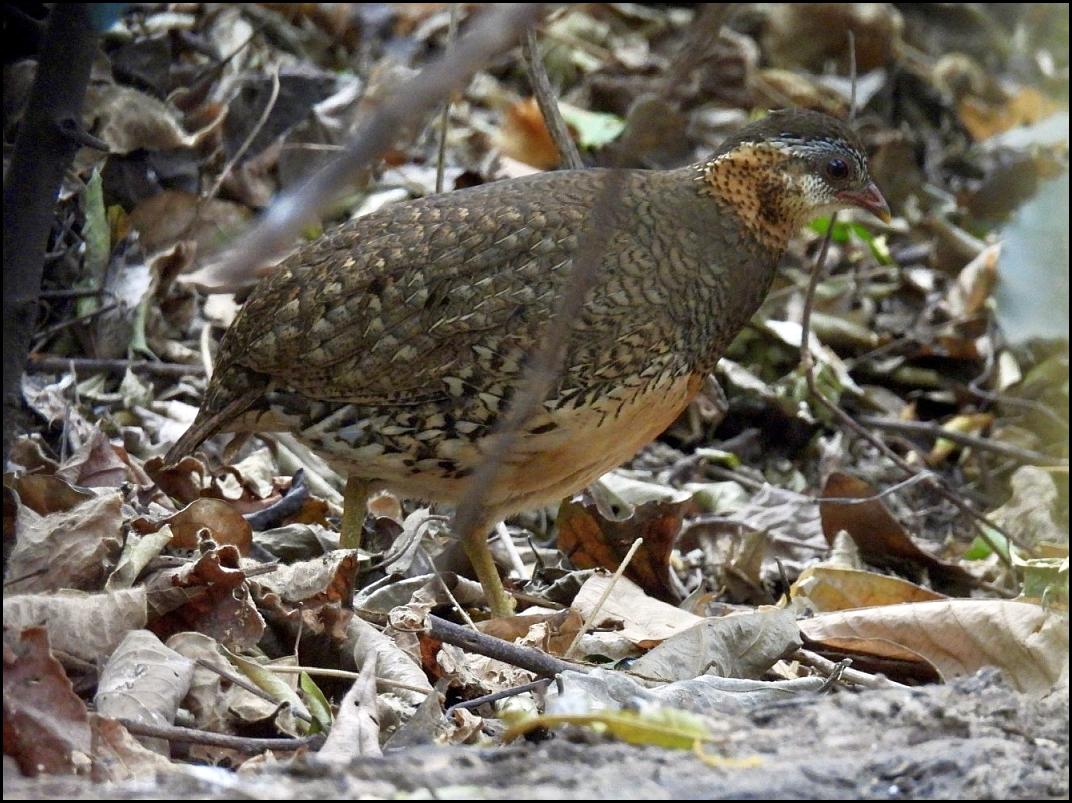
Scaly-breasted Partridge
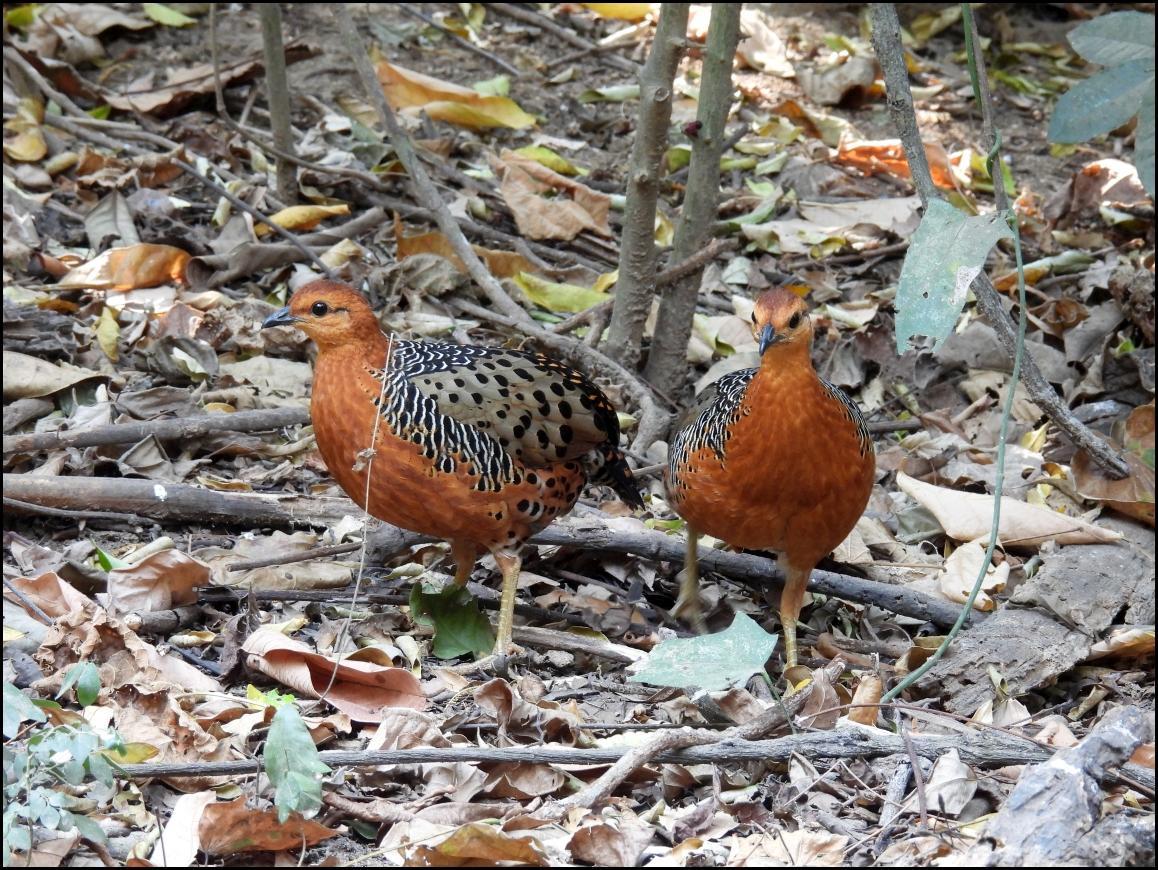
Ferruginous Partridges
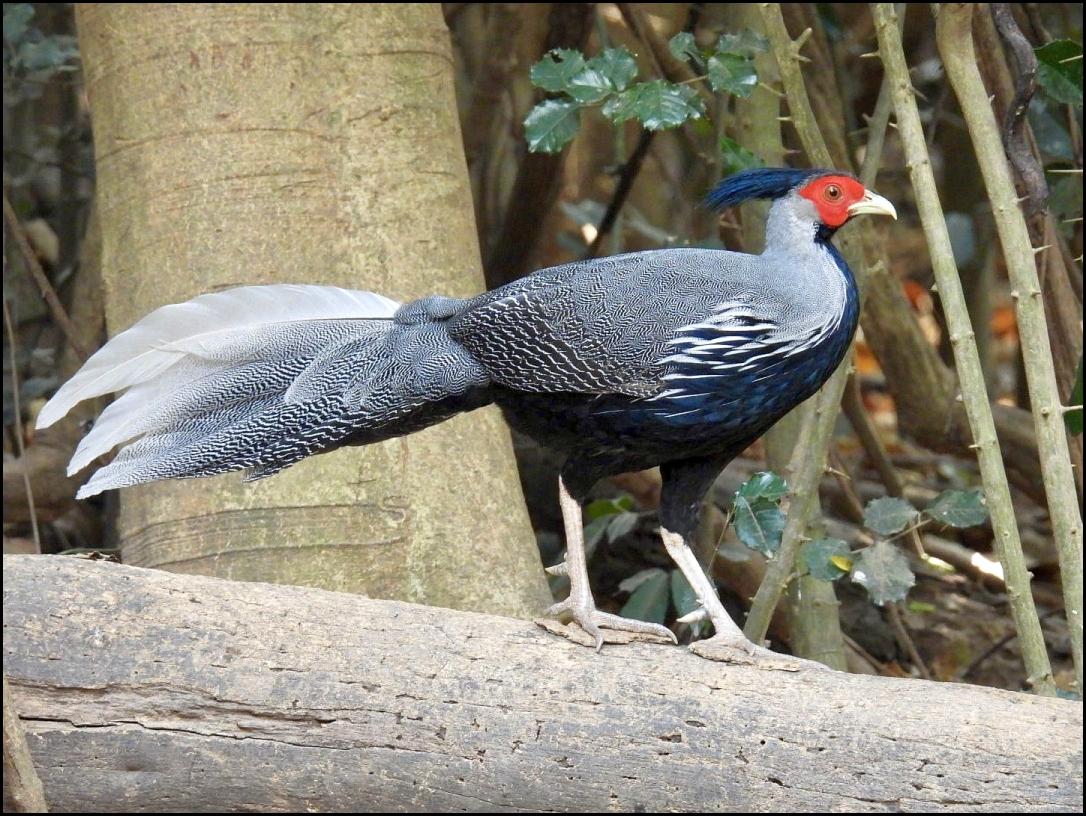
Kalij Pheasant
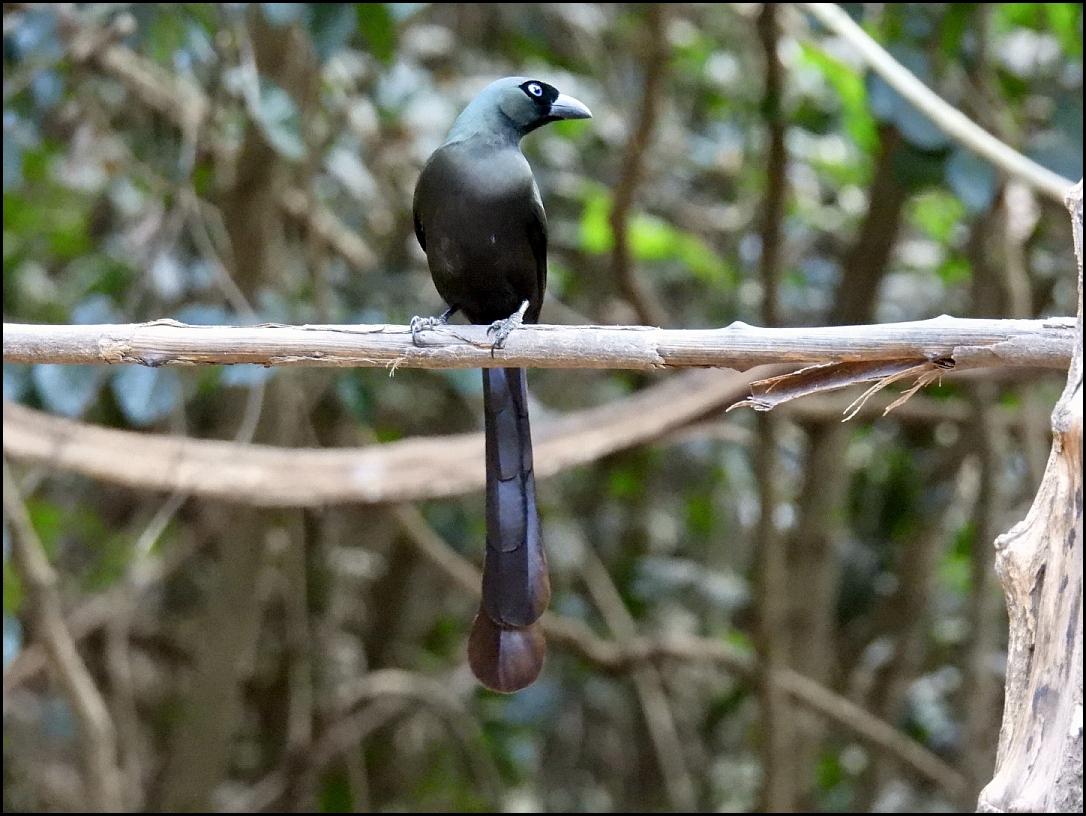
Racket-tailed Treepie
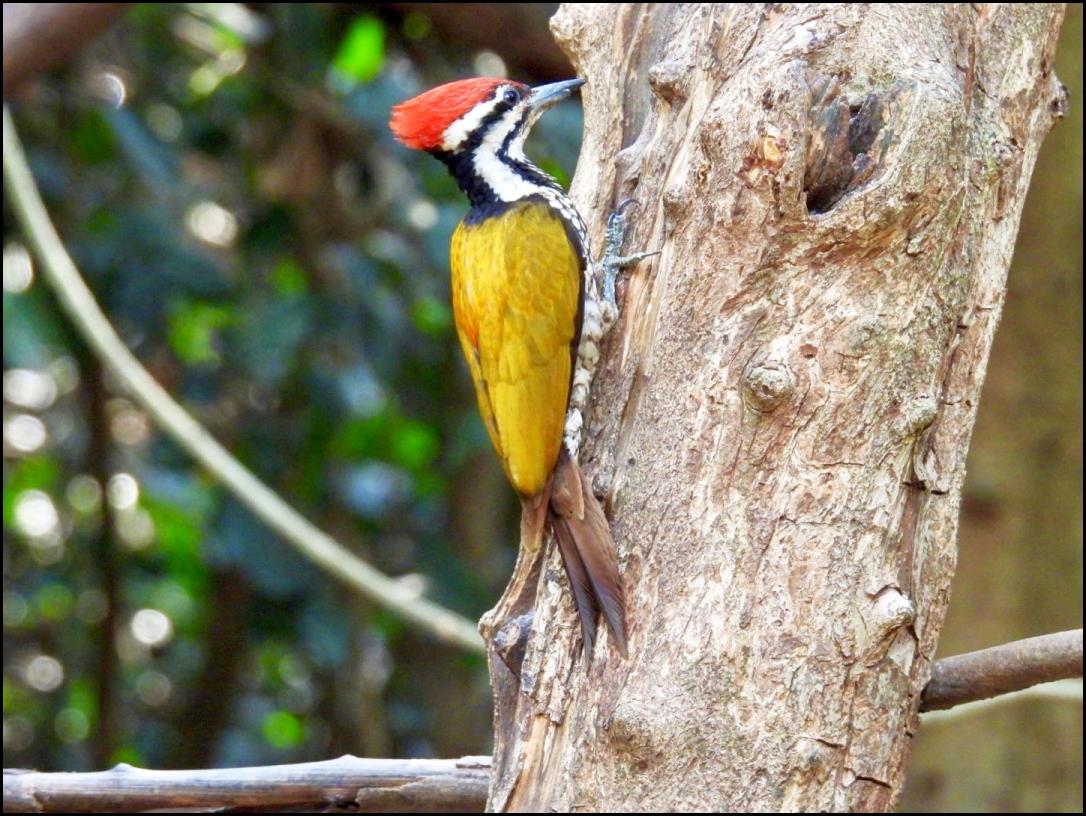
Common Flameback
A LESSER ORIENTAL CHEVROTAIN (Mouse Deer) appeared out of the forest towards the end of our session. It smaller than the Red Junglefowls that were there. We also had many other species that we’d already seen on the trip.
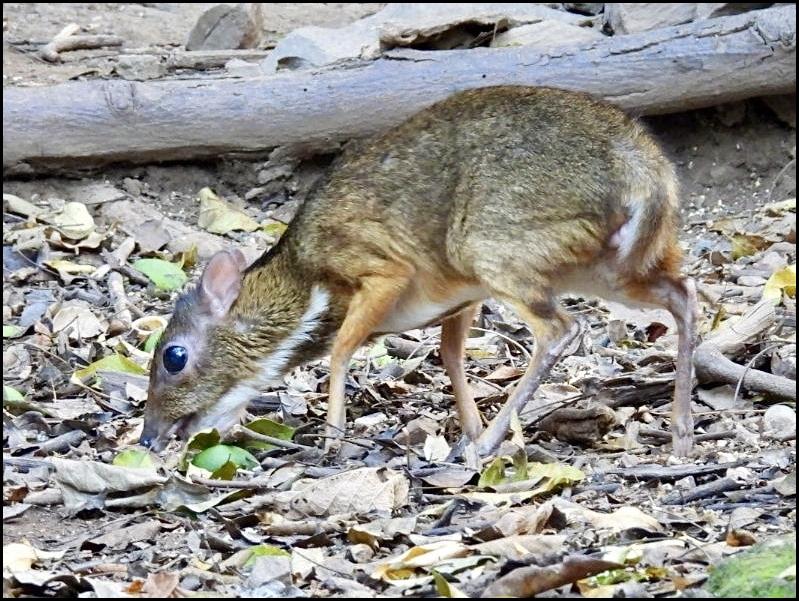
Lesser Oriental Chevrotain
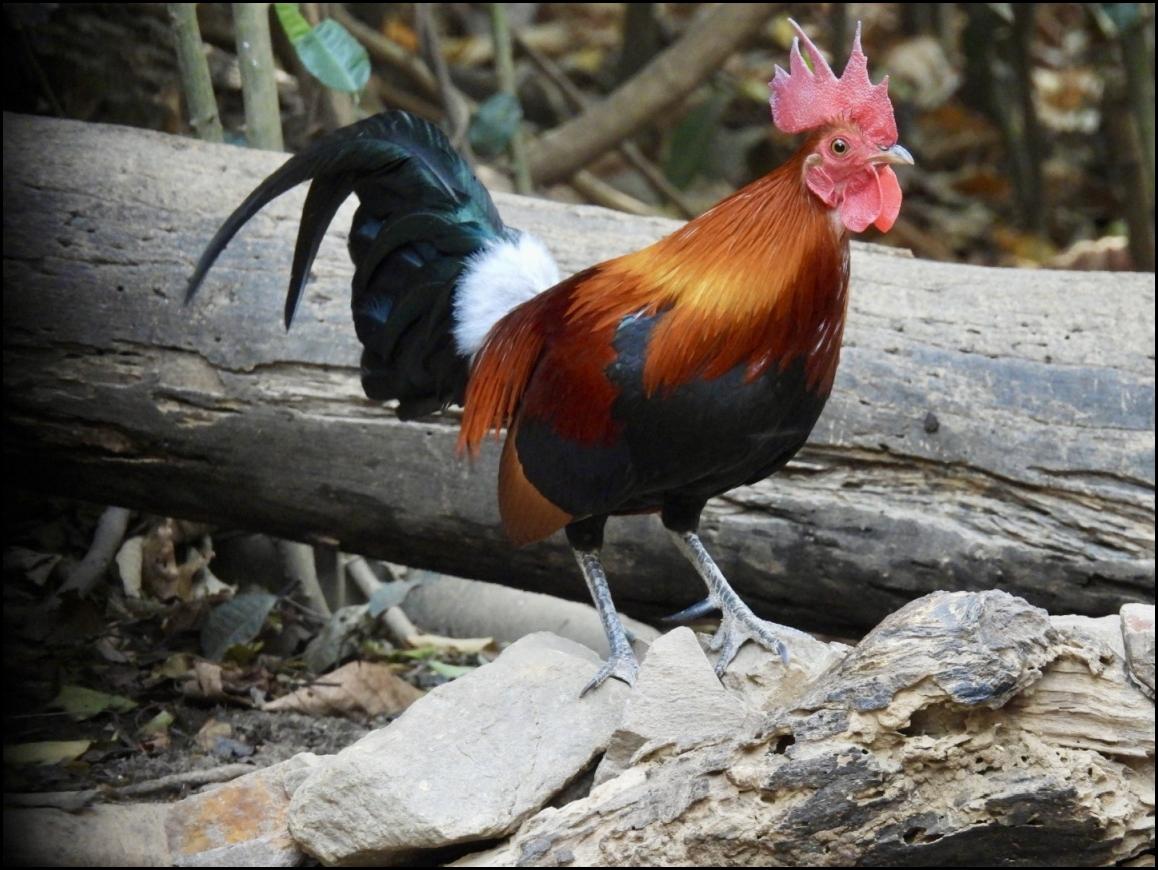
Red Junglefowl
This really is a must-do if you are staying near here. Possibly the best 3 hours birding of the trip.
After dinner I walked around the grounds of the lodge but the only thing of interest that I found was a GREATER DEATH’S HEAD HAWKMOTH.
Day 9 – February 22nd – Travel Day
I was up at dawn for some final pre-breakfast birding as today we were leaving. The Plaintive Cuckoo was still in the allotments, a White-breasted Kingfisher was sat by a pond and an Asian Koel was loudly waking the world. There was a passage of swallows and swifts happening. I counted 20+ Barn Swallows and 6 Himalayan Swiftlets and amongst them was an EASTERN RED-RUMPED SWALLOW. Finally, as I was returning for breakfast, I found a BRONZED DRONGO near the garden exit.
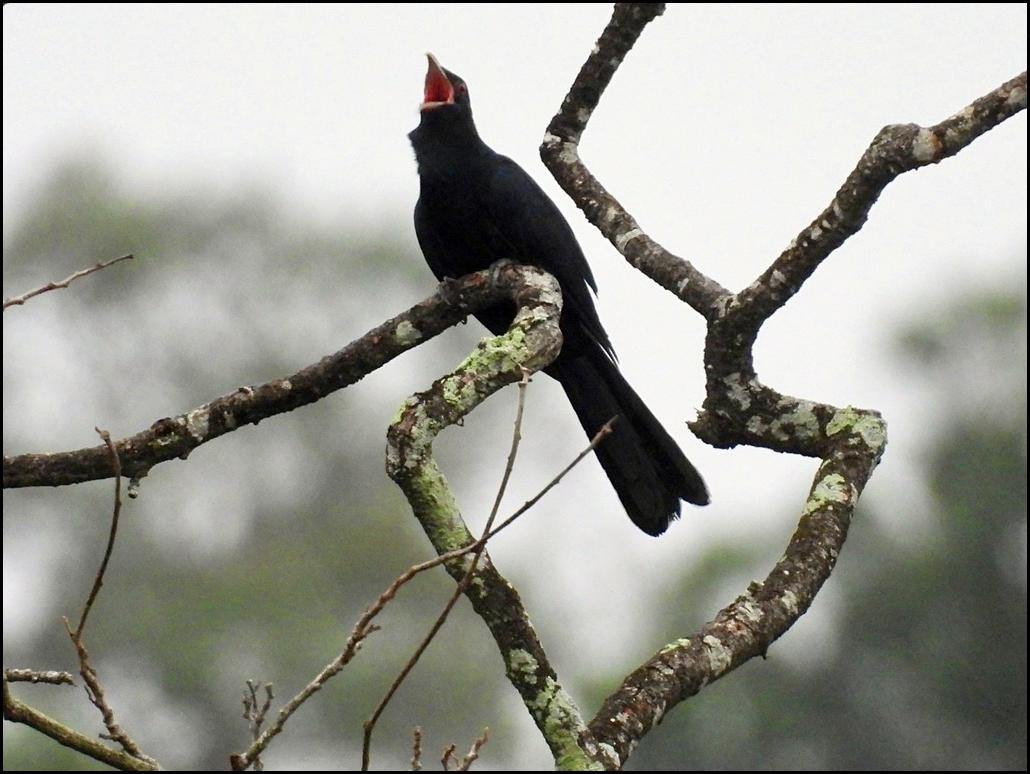
Asian Koel
After breakfast, our pre-booked transport arranged with the Lodge, arrived to take us to Hua Hin railway station (THB 1500 £34). We’d booked tickets to take us south to Surat Thani, from there we would get a taxi to Khao Sok. Given our location the train was the fastest option to take us onwards. It cost THB 986 (£22.50) for 2 reserved seats in an air-conditioned carriage. At Hua Hin we bought bottled water and were allowed onto the platform 5 minutes before the train arrived. It was dead on time, we were pointed to our carriage and made ourselves comfortable for the journey, which would take just under 6 hours. It was a comfortable journey, but the air con was a bit too cool for me. Train staff came round at regular intervals selling food. Initially we were sat a few seats apart but as the train started to empty along the way we were able to sit together.
Birds seen along the way were generally large ones I could ID from the train. There were many Eastern Cattle Egrets, Asian Openbills, a Great Egret, Red-wattled Lapwings and at stations when we stopped 4 Red Collared Doves, a Black Drongo, Common Mynas and Feral Pigeons.
On arrival at Surat Thani, I was immediately approached by an official taxi supervisor, stating we were going to Khao Sok, he said that will be THB1800 (£41). I could’ve haggled or used the Grab app, but we were hot and tired and just wanted to get to our hotel. He waved and a flat-bed truck pulled up. The driver instructed us to sit inside the cab, 2 people were already in the back, our cases were put there, and they got off soon after. The driver was quite jovial and asked many questions of us, and showed us his big bag of medications, which he said came with old age. He asked if we minded if we picked up his wife, we said fine and were underway. For some reason, the transfer time on the net was showing as 2+ hours but it was only an hour. He drove very fast, and we had no seat belts. I wasn’t sure he was a proper cabbie at all, maybe earning a bit extra whilst taking his wife to Khao Sok. It soon became clear that he was not sure of our hotel location, and we struggled to convey where it was. Putting the route into Google Maps I found a picture of Khao Sok Nature Place, our hotel. Recognising the distinctive picture of the hotel, a big smile and a thumbs up confirmed it was all good. Nature Place cost us THB 2430 (£59 for 2 nights).
We checked in and I went out onto the balcony just as dusk was falling. An adult Yellow-vented Bulbul was feeding 2 juveniles on the tree in front.
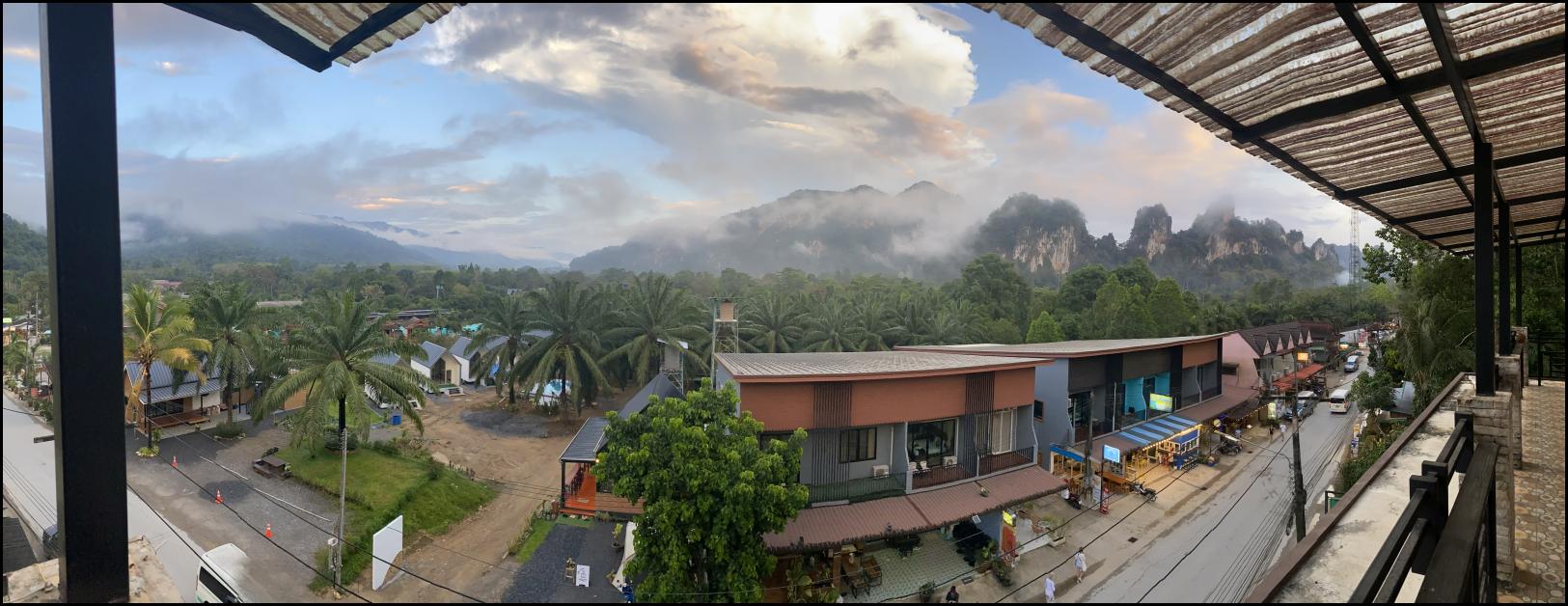
View from the hotel rooftop breakfast area
After resting for a while we ventured out to by some snacks in the shop next door and to find a meal. Khao Sok seemed a bit like a backpackers/gap year sort of town and our presence certainly raised the average age. The town straddled a river with a large bridge across it. It followed the format of restaurant, massage parlour, weed shop, laundry, tourist trip organisers and then repeat. We found a restaurant which looked good with seating inside away from any mozzies and enjoyed a meal and a welcome beer. On the way back to the hotel we had a coconut ice-cream before an early night for our day out in the morning.
Day 10 – February 23rd – Back to the Forest and Wet, Wet, Wet!
We had booked with Khao Sok Travel a day birding, so were up early and ready to go. Our guide Jane arrived at 6:45am, she was a young local guide who spoke perfect English, which was a bonus. We hadn’t realised we’d be walking all day but that was fine by us.
Jane led us through the town stopping to point out the Long-tailed Macaques by the bridge. We turned right after the bridge along the riverbank and Jane started to point out birds and identifying the ones I didn’t know. There were a few lifers here, a RUFOUS-FRONTED BABBLER, a bright yellow COMMON IORA and a pair of GREEN-BILLED MALKOHAS, a type of cuckoo. There was also a more familiar Grey Wagtail. In the near distance 12 raptors were warming up in a dead tree, they were all BLACK BAZAS, a small piebald raptor with a long crest, a bird I was pleased to see.
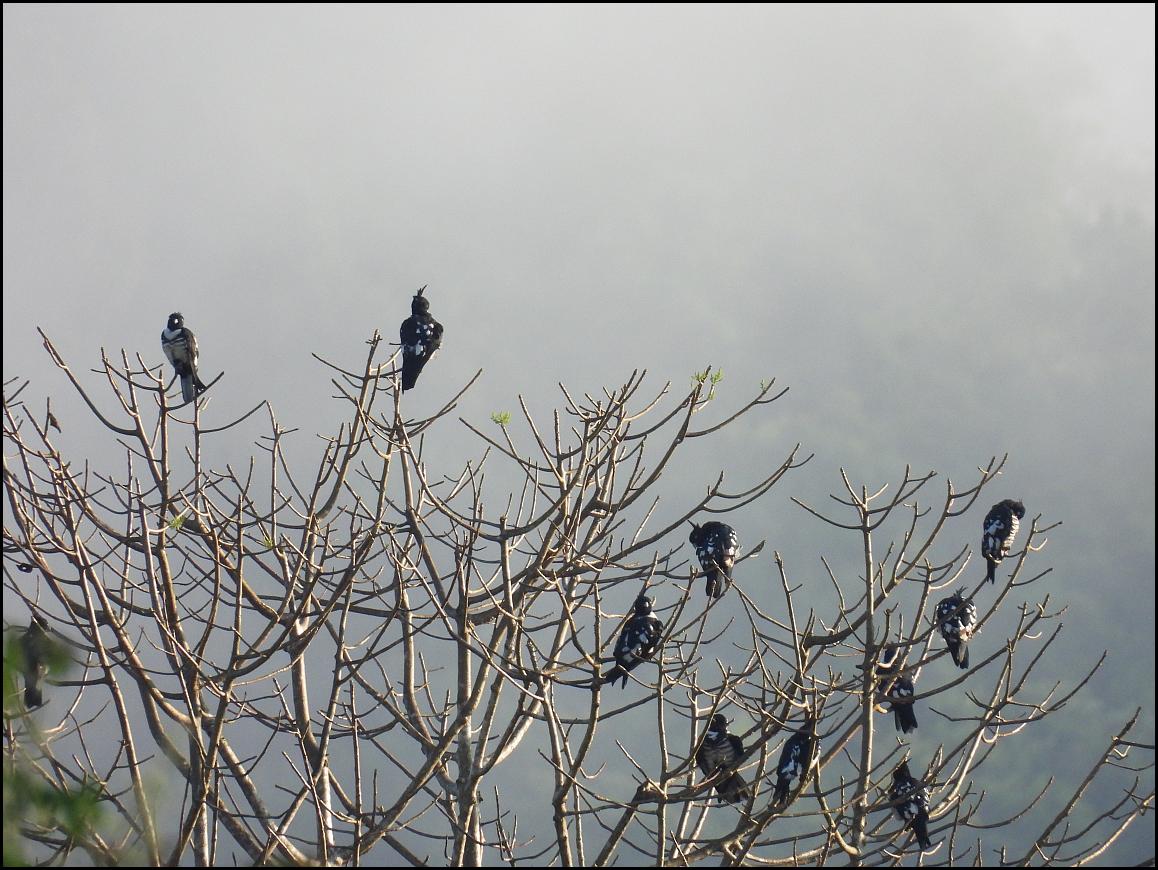
Black Baza roost
Further along the path we found a BROWN-THROATED SUNBIRD, 2 RED-THROATED BARBETS, a LITTLE SPIDERHUNTER, a pair of much-wanted ASIAN FAIRY BLUEBIRDS and an ORANGE-BELLIED FLOWERPECKER. The Fairy Bluebird was a bird that was in the Brooke Bond Tropical Birds tea card set that I’d collected and still had, one I’d always wanted to see, so mission accomplished.
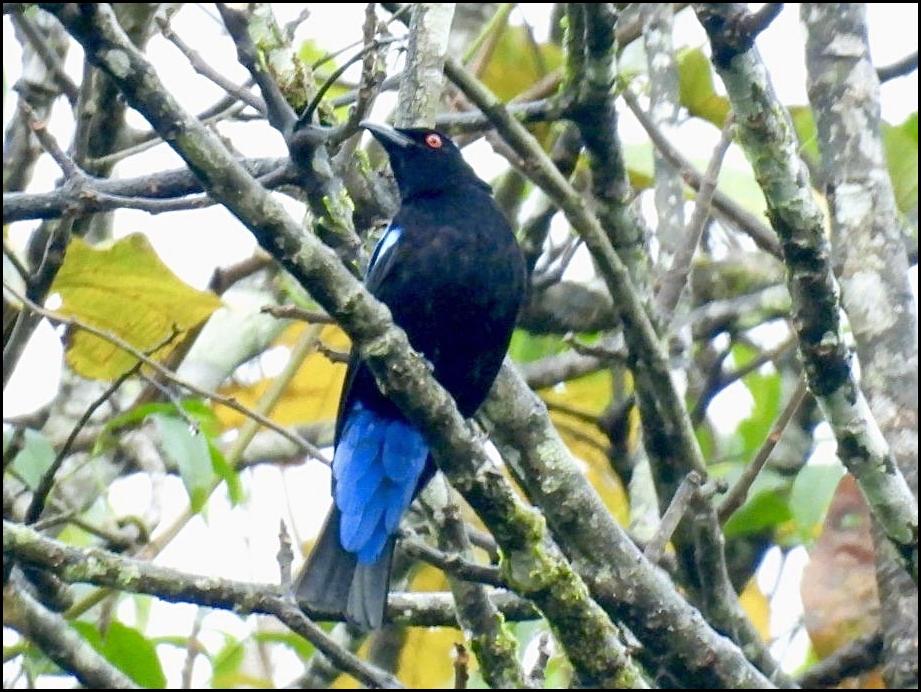
Asian Fairy Bluebird
Bridgette made the mistake of opening a cake packet in earshot of the Macaques and they appeared as if by magic.
We headed off towards the National Park through some rubber plantations, which were interesting to see, Jane pointed out an ORANGE-WINGED FLYING LIZARD and also a distant Stump-tailed Macaque. Jane organised our permits when we arrived at the entrance, we had to sign in for the day. She led us to the shade of a café, where breakfast was delicious Dragon fruit and cold drinks and also picked up packed lunch she had arranged.
Setting off onto the trail she showed us a large Stick Insect, which was perfectly camouflaged. A Crested Serpent Eagle cruised the ridge above us. The first bird we saw was an Arctic Warbler, a species that had led me a merry dance at home and I’d only seen for the first time last autumn. We saw both SPOTTED FOREST SKINK and COMMON SUN SKINK on the edges of the trail. Next was a party of 3 OCHRACEOUS BULBULS and a little further a WAGLER’S PIT VIPER was coiled up about 15 feet up in a bamboo stand, Bridgette avoiding a look. We saw many other birds but nothing new for the trip.
We arrived beside the river, stopping for lunch, some tasty chicken fried rice with a spicy sauce. Jane said that it was going to rain and on cue a distant clap of thunder sounded. She stated, ‘we’ve been out for 7 hours, and I think we’d better turn back’. The first few spots of rain started to patter through the canopy, in a few minutes it turned to torrential. The trail became a stream, and we got wetter than we’d ever been. Nothing was dry with the exception of my passport and wallet which I had in a dry bag inside my rucksack. By the time we arrived back at the café naturally the sun was coming out and the rain was stopping in the way it only seems to do in the tropics. Jane called for the driver to take us back to our hotel, we agreed it would be both impractical and uncomfortable to continue. We thanked Jane and returned to our room to get everything drying, especially my field guide which was most important.
Bridgette took a bag of our clothes to the laundry opposite and then stayed in, I went back out to eke out another species or two for the day. I returned to find the Bluebirds and got better photos. I also found 2 PACIFIC SWALLOWS and an adult GREY-FACED BUZZARD.
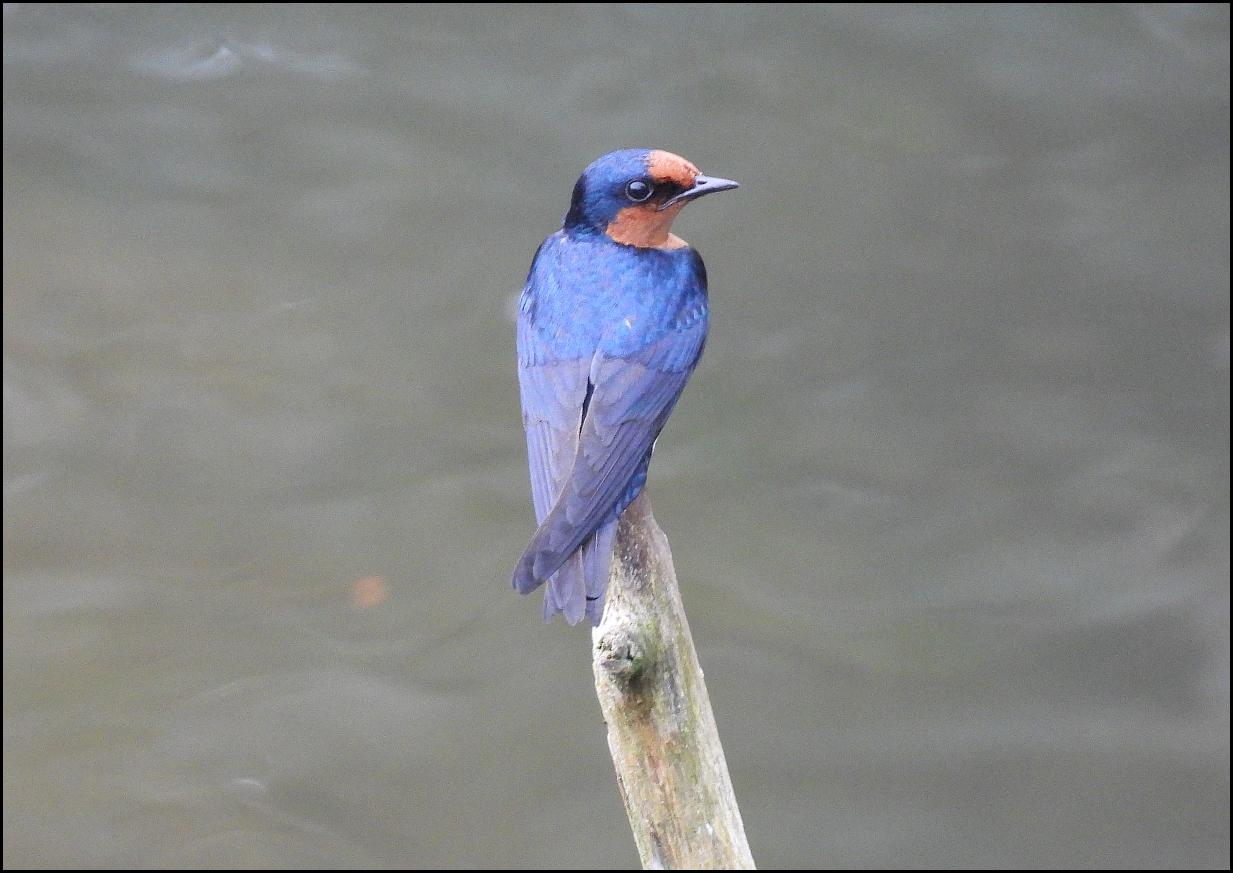
Pacific Swallow
Day 11 – February 24th – Back on the road
I was out early and walked through the rubber plantations to the edge of another river. I saw mostly common species but more notable were 10+ House Swifts, a Striated Heron, a male Asian Fairy Bluebird, two Pacific Swallows and the Grey-faced Buzzard again. At the river’s edge I found an ORIENTAL HOBBY perched in a dead tree.
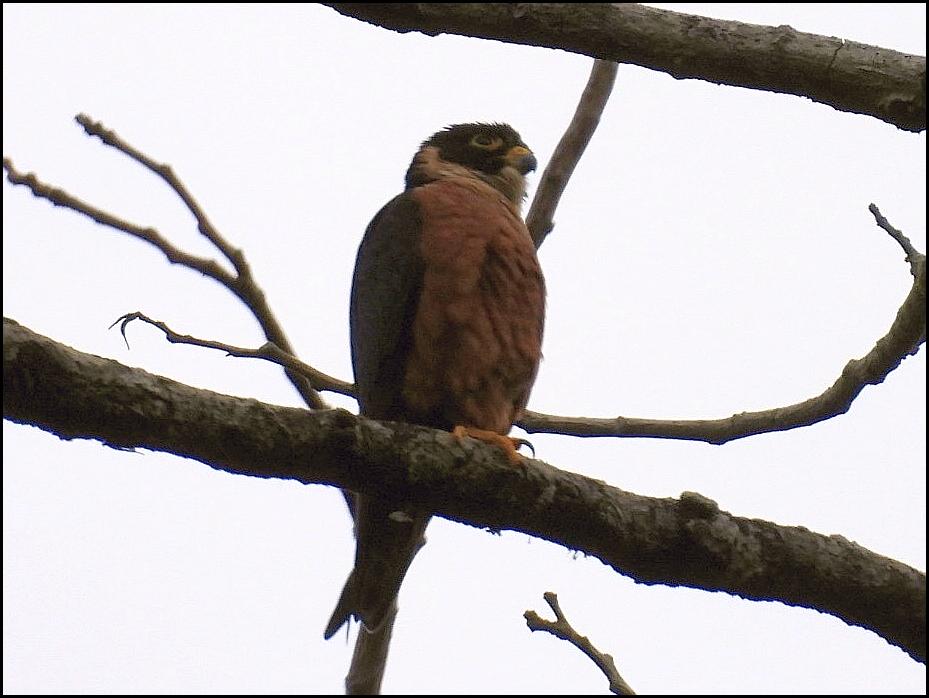
Oriental Hobby
After breakfast we packed up and I searched for a taxi to take us the hour south to the coast at Khao Lak. I struggled to find anyone on the Grab app that would take the fare. Eventually I found a driver, but he wanted THB 2000 (£45). We had no other option as we needed to be there by 2pm so took the ride.
We checked in to the Rakkawan Residence THB 5922 (£135 for 4 nights with breakfast). Bridgette needed to check in to the dive centre to organise her kit for her upcoming night away diving from a Liveaboard boat, the walk was a lot further than we thought, and it was extremely hot.
Whilst Bridgette checked in, I birded nearby finding a Green-billed Malkoha and a Common Sandpiper in a flood defence near to the beach. Walking back, we saw 2 Chestnut-headed Bee-eaters and I found a Praying Mantis.
Back at the hotel some unexpected rain had set in for the evening, I got a cup of coffee and birded from the balcony. For an urban area it was pretty good and in half an hour I added 3 juvenile ASIAN GLOSSY STARLINGS and a cracking red BANDED WOODPECKER, spotted by Bridgette, and a supporting cast of 3 Black-naped Orioles, 2 Pacific Swallows, 10+ Edible-nest Swiftlets, 6 Tree Sparrows, an Asian Koel and an Asian Openbill stork.
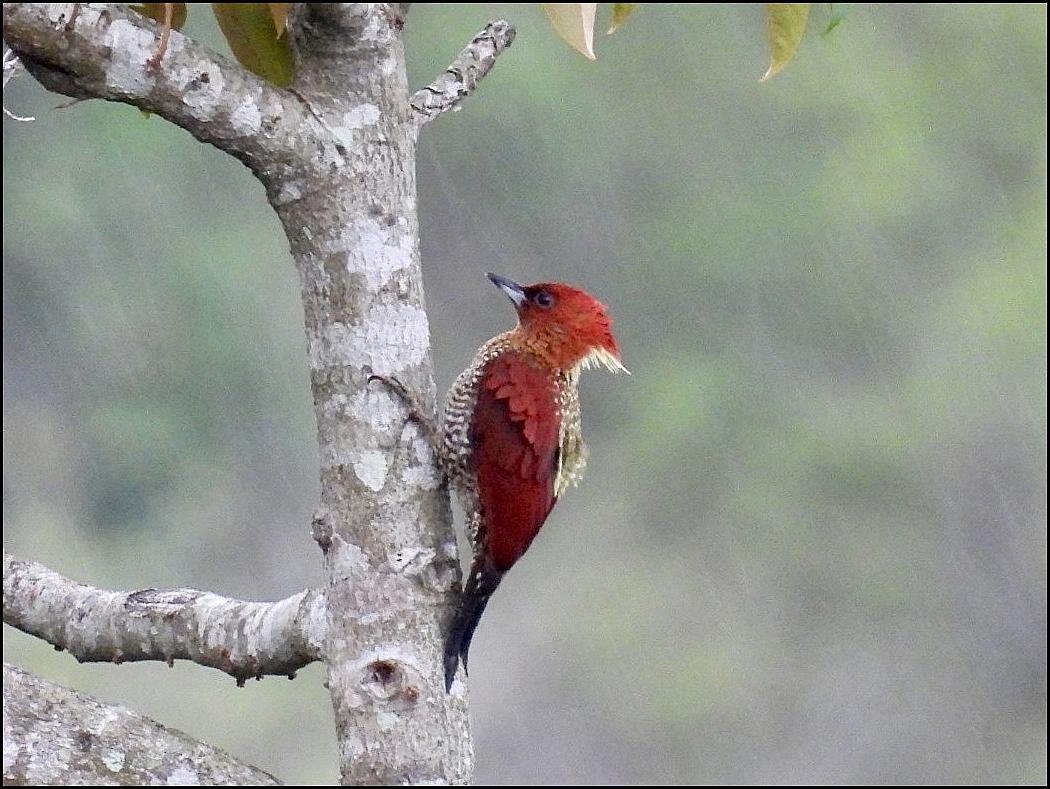
Banded Woodpecker
We had a great meal in the restaurant next to the hotel before an early night in as Bridgette was off to sea early in the morning for two days diving.
Day 12 – February 25th – Hard yards, small rewards
Bridgette’s taxi arrived to take her to the dive centre whilst we were eating breakfast. I was alone for two days so what to do? Go birding of course. I chose to go to Khao Lak Lamru National Park. It was about an hour to walk to the park entrance. I was all uphill and very warm already. Along the way birds included 15+ Edible-nest Swiftlets, 4 House Swifts, 4 Pacific Swallows and a White-throated Kingfisher.
On arrival I paid the entrance fee THB 100 (£2.25) and given a map. I decided to take the 3km Hat Lek Nature Trail, which seemed a reasonable idea at the time. The trail is described as an adventure for the ‘fleet-of-foot and may be challenging for those with walking difficulties’. I thought on a nature trail I would see birds and wildlife. Wrong! I saw nothing other than some nice fungi. It was probably designed by Bear Grylls and was very challenging to say the least.
Eventually I came to a small sandy beach, which coincidentally was called Small Sandy Beach. There was a refreshment hut there and I bought a well-deserved Pineapple and Coconut smoothie and got my breath back. I found the way out was a simple 400m trail back to the road. I still hadn’t seen a bird, but on leaving I found a Black-crested Bulbul by the beach.
I headed to the other side of the reserve to Khao Lak beach. It was pretty quiet with just a couple of families there. On the rocks, where it was low tide, I found 2 PACIFIC REEF HERONS, a Common Sandpiper, a juvenile Pond Heron and a Grey Wagtail. There were many MOTTLED LIGHTFOOT CRABS on the rocks. I sat in a pagoda out of the sun and ate my lunch, Spicy Lobster Pringles and water, then headed back to the hotel.
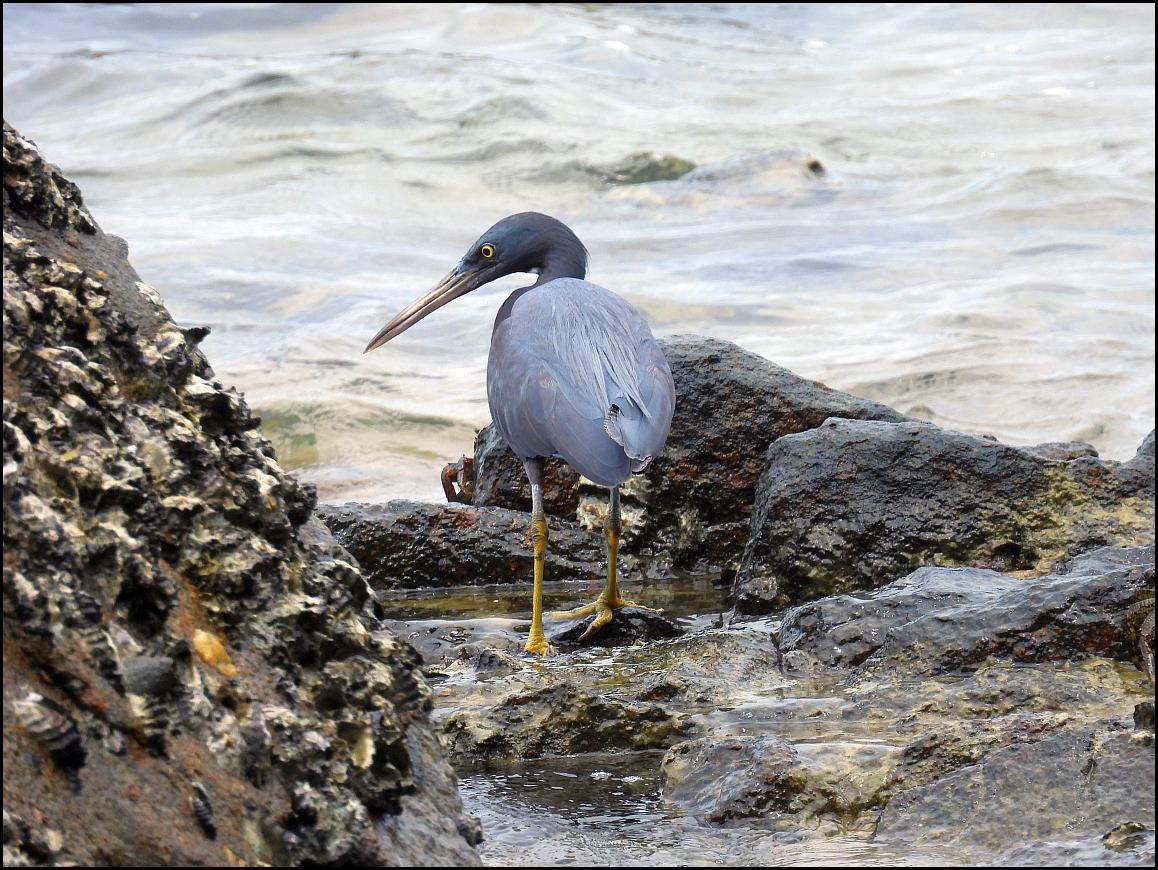
Pacific Reef Heron
On the steep incline up from the beach I found a BAKER’S BULBUL, then I took the hot walk back to town which produced more birds than the reserve. I had 10+ Tree Sparrows, a Brown Shrike, a Plaintive Cuckoo, 2 LARGE WOODSHRIKES and an OLIVE-WINGED BULBUL.
At the hotel I had a coffee, rested up for an hour before a walk before dusk. I headed up the lane next to the hotel called Soi Bang La On. On the lane were 20+ Red Junglefowl, including 12 roosters. They looked like pure Junglefowl but surely this close to civilisation they must’ve been hybridising with domestic chickens. I didn’t see much other than a Brown-throated Sunbird and a paddock had 10+ Edible-nest Swiftlets above it and with them were 2 GREY-RUMPED TREESWIFTS, the last tick of the day. I did walk down to the beach to see the sunset, but I was too early, and it was very busy, so I went home.
In the evening, I ate in the restaurant next to the hotel before a relatively early night for me. I hoped Bridgette was enjoying her night at sea.
Day 13 – February 26th – All by myself
I thought I would go a bit further afield today so took a taxi after breakfast to the Ton Pling waterfall, 5km beyond Khao Lak Lamru NP. Because it was the dry season the waterfall was more of a gentle flow. There were few birds around here, of note a Chestnut-headed Bee-eater, 10+ Pacific Swallows and a Stripe-throated Bulbul.
I walked back to the National Park even though it was already very hot. A Brahminy Kite flew over carrying a stick, presumably nesting nearby. I came to an open area with an Asian Elephant feeding next to the road. I presumed it wasn’t wild, but it was quite a way from the Elephant Sanctuary, not shackled and fully capable of walking out of the open drive if it wanted. Other than a Brown Shrike and a few dragonflies and butterflies I saw little else.
It took about an hour back to the entrance, where I was greeted by the same warden as yesterday when I bought my ticket. Today I shunned all thoughts of the Hat Lek Nature Trail and instead went to a refreshment bar overlooking the sea. I bought my favourite Pineapple and Coconut smoothie and sat, letting the birds come to me. It was a plan that paid off. In half an hour I had a Scarlet-backed Flowerpecker, a very showy INDIAN CUCKOO, a Red-throated Barbet and an ASIAN RED-EYED BULBUL.
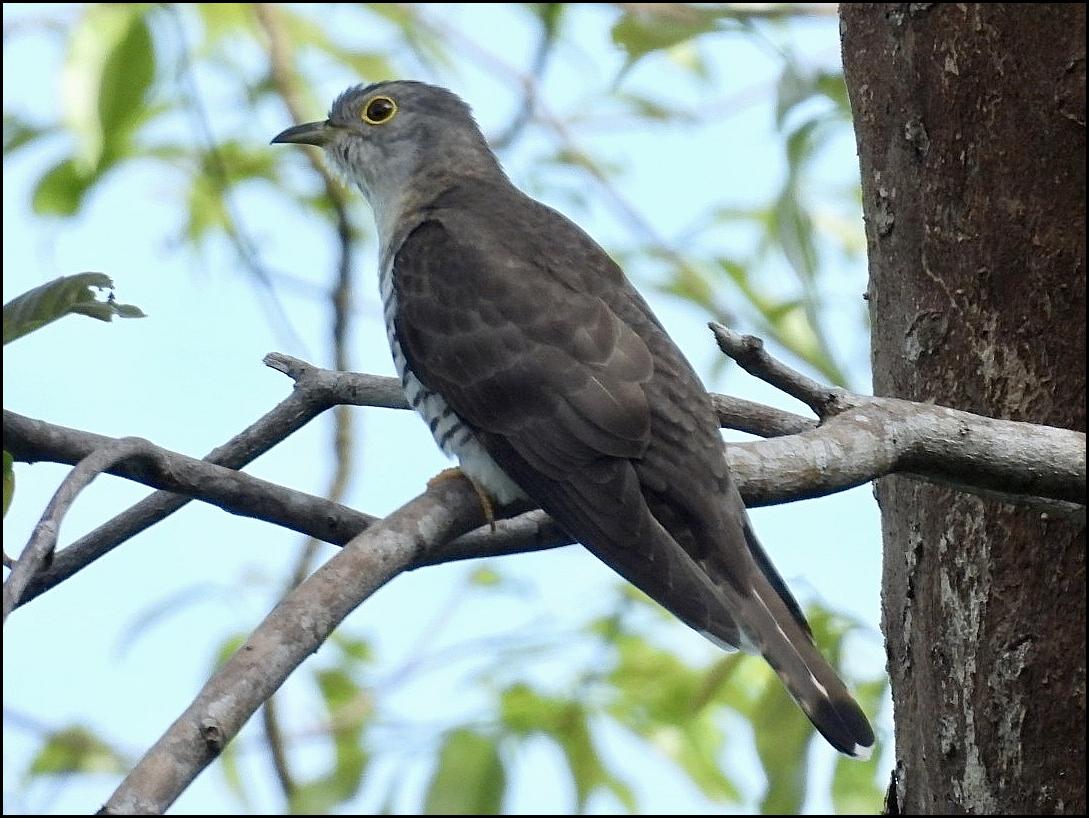
Indian Cuckoo
I walked down to Khao Lak beach, but it was high tide so only the Common Sandpiper was there and a second Indian Cuckoo. I headed back to the hotel for lunch, bought at the 7/11. It was a very hot and tiring 3km downhill trudge, so was glad to get back. I was smashing step records on this holiday for sure.
After lunch I walked to the Phru Sai river mouth, the road to it passed through some interesting fields. It was a 6km round walk but figured it might produce a few good birds and would fill my afternoon until Bridgette got back.
I was right, there were lots of birds, most of them Chestnut-headed Bee-eaters, which gave stunning close views. A male Common Iora, a Green-billed Malkoha, a Brown Shrike, 2 Barn Swallows, a Common Tailorbird and a Common Sandpiper as well as commoner species added to my day list. A LINEATED BARBET was another great addition to my barbet list, showing very well on a dead tree. In a little swampy area near to the river mouth were 50+ RING-LEGGED FIDDLER CRABS.
On the return journey as I got to the main road, I saw a Brahminy Kite and whilst watching it an eagle flew into view. It was a WHITE-BELLIED SEA EAGLE, it was magnificent. A great bird to finish my day on.
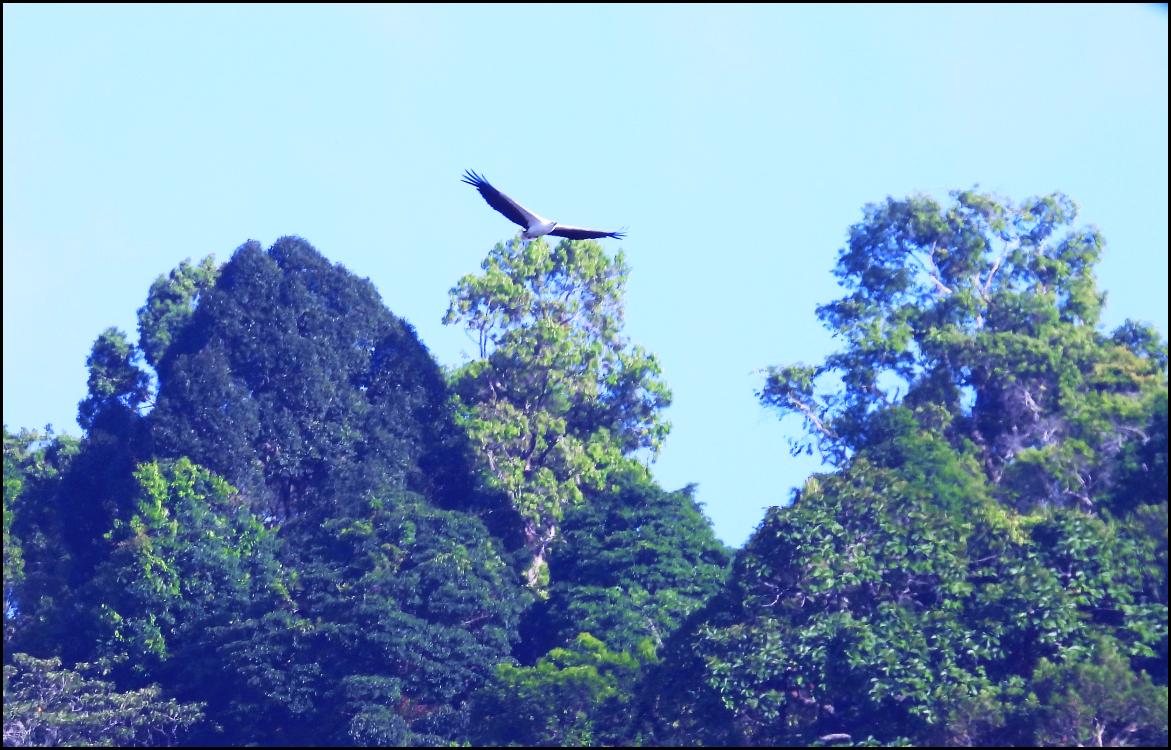
White-bellied Sea Eagle
When I got back to the room I was pleased and surprised to find Bridgette back already. There’s only so much of my own company I can cope with. Her dive trip hadn’t been as successful as hoped due to sea conditions, one of the dive sites was ‘blown out’ so alternative sites were substituted. A bit like birding at times, the wildlife or weather may not co-operate. I was sorry for Bridgette, she will have to come back and try again in the future.
Day 14 – February 27th – Local wanderings
Today was going to be a relaxing day around Khao Lak but still ended up walking 12 ½ miles. After breakfast we walked to the beach, I was pleased to find a Hoopoe on the way, one of my favourite birds. On reaching the beach we decided to walk along the beach to the right and just see where we ended up. A large Kingfisher flew by me calling loudly but I didn’t see it well enough to ID it. I knew that it was new to me though.
We paddled along the shoreline, saw a Whimbrel on the rocks, and eventually came to a deep channel crossing but we didn’t have swim gear. No problem, an enterprising young lad had a pull raft which took us across for THB 20 each (0.45p each) to dry land.
We walked into town and found Wat Phanat Nikhom temple, which we explored for a while. It was a beautiful building and apart from one other family were the only visitors. An adult Asian Glossy Starling was here, which was nice, the others I had seen had been juveniles.
Walking the back roads, we found a lake, where I saw a bright yellow Common Iora. We found ourselves at the Tsunami memorial and museum. Khao Lak was the worst hit place in Thailand by the 2004 Boxing Day Tsunami. 4,186 people were killed, a mix of locals and tourists, nearly 6,000 were injured and almost 2,000 were never found. We had already seen memorials to the missing on a few palm trees along the beach. The devastation was unimaginable. If you want to read more this is good link https://khaolakcenter.com/the-khao-lak-tsunami-a-tragic-chapter/
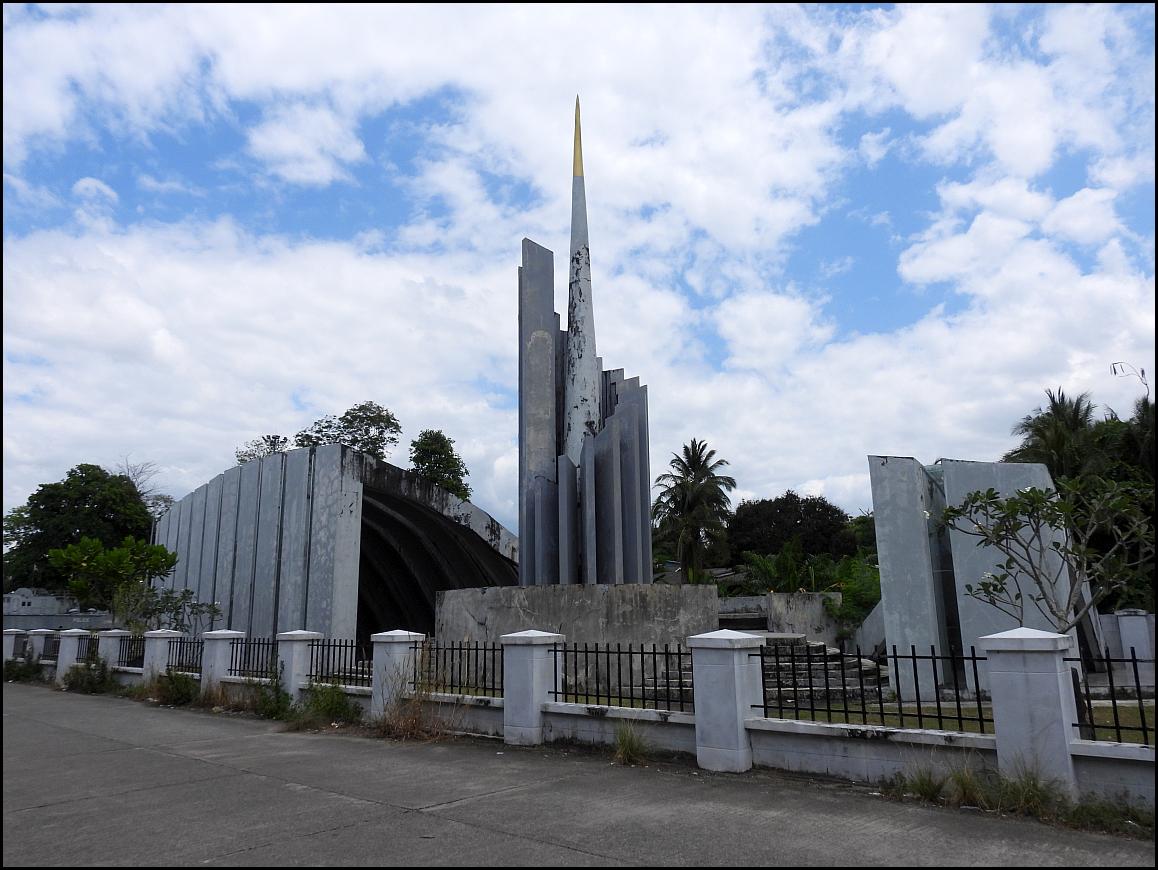
Tsunami memorial
After this we took a lazy lunch in a restaurant just outside the town centre, to cool down and reenergise. On the way back home, I found a Paddyfield Pipit singing loudly in the middle of town competing with the traffic noise.
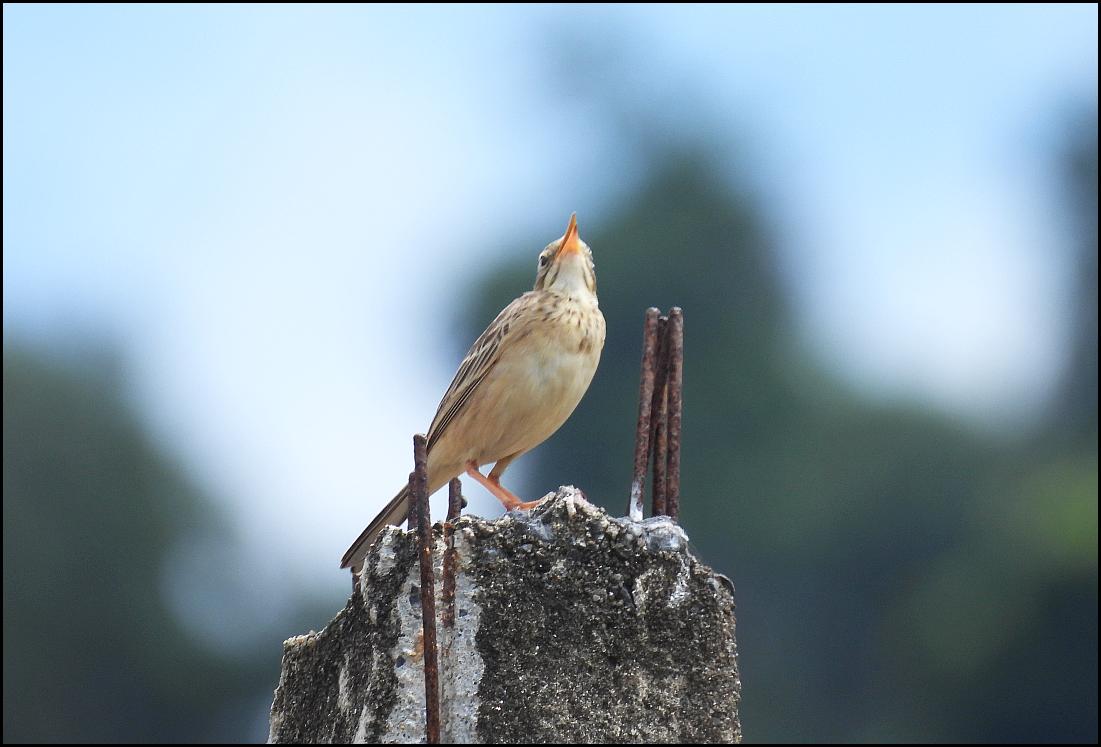
Paddyfield Pipit
Bridgette returned to the hotel, but the mystery kingfisher was still nagging at me, so I walked back to the beach. I found it sat on the rocks exposed at low tide almost immediately and quickly identified it as a COLLARED KINGFISHER. When it flew off it was joined by a second bird.
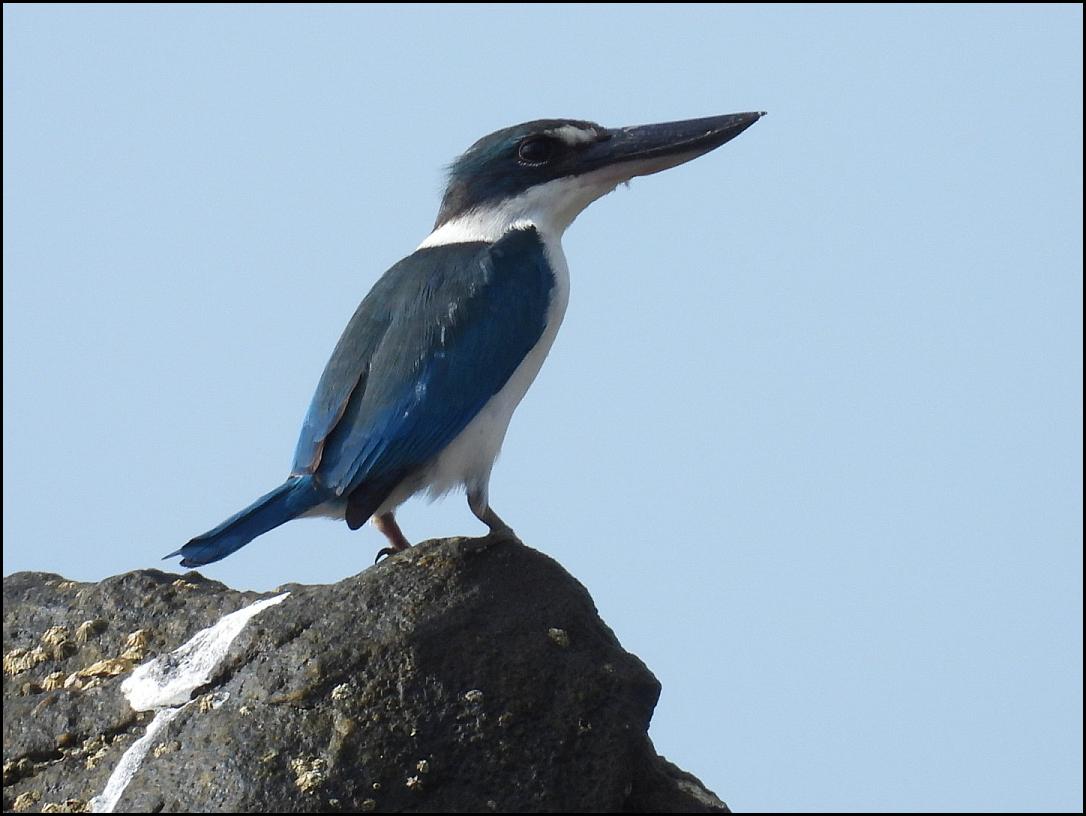
Collared Kingfisher
Day 15 – February 28th – Homeward bound
Today we were going home so were packed before breakfast. We had a morning to fill, we were on an early evening flight. We visited Ton Chong Fa waterfall, a forested area, around 40 minutes out of town. Our taxi driver dropped us off, with the promise she would pick us up at 11:30am, as we hadn’t paid, we were confident she’d be there.
It was a stiff walk up through the forest to where the waterfall trail began, and then the trail got steeper. We made it to the top, but the waterfall was fairly slow due to being the dry season.
It was very quiet and although there were fish and butterflies to look at, we only saw 3 birds, a Little Spiderhunter, a male Asian Fairy Bluebird and a HEART-SPOTTED WOODPECKER, my final lifer of the trip.
After lunch a taxi took us to Phuket airport for the long journey home. The last bird at the airport was a Common Myna.
The journey home went fairly well although we experienced some uncomfortable turbulence for quite a while over the Indian Ocean. The flight from Doha to London was much smoother and arrived safely into a very cold English morning. From Heathrow it was a coach back to Gloucester and onwards to home.
As a first trip to Thailand, we soon realised we had not planned enough days in each place. We will return to explore more of this fascinating country, its birds and wildlife. The Thai people were extremely helpful, polite and always smiling.
If you want any more information don’t hesitate to contact me.
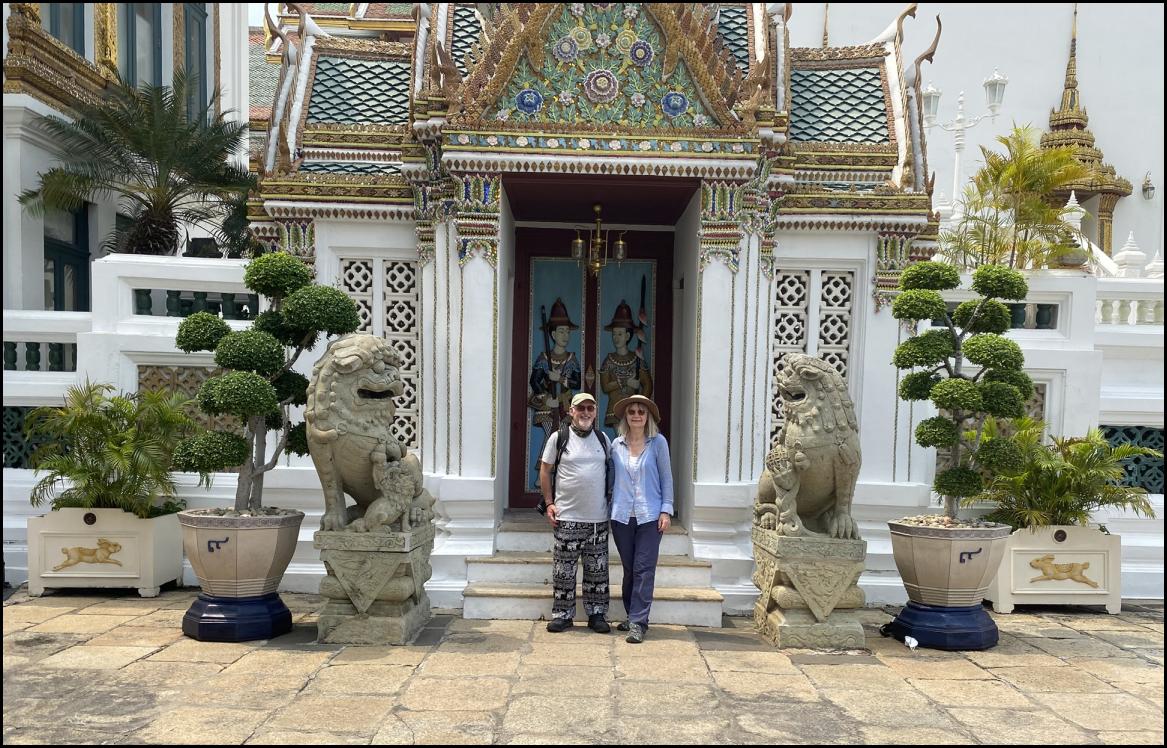
Mike & Bridgette King The Gloster Birder © 2025
 County news, sites to visit, trip reports and other information about birds in Gloucestershire and beyond, since 2000.
 theglosterbirder.co.uk